4 min read

Glycols and Glycol Derivatives: 2025 Market Review

Glycols and Glycol Derivatives: 2025 Market Review

Monoethylene Glycol (MEG)

A Tight Start to 2025

North American MEG entered 2025 in a relatively tight and higher-priced position. MEGlobal’s benchmark hovered near 34 cts/lb in March, while U.S. contract prices for fiber, industrial, and antifreeze grades landed in the 0.21–0.24 cts/lb range. Supply was constrained by unplanned outages and a turnaround/failed restart at Lotte's Lake Charles facility. Meanwhile, seasonal demand was underwhelming, and PET-related offtake lagged. Concerns about potential U.S. tariffs on Canadian rail deliveries briefly prompted some suppliers to add surcharges before the tariff action was postponed.

Softening Through Midyear

Through Q2 and Q3, both contract and spot prices gradually softened. MEGlobal reduced its benchmark to 33 cts/lb in May. Regional production remained partially constrained by planned downtime and voluntary rate cuts; however, availability improved, and PET demand decreased, creating pressure on spot markets. By September, the benchmark had eased to 31 cents per pound, and market activity across the Americas was described as sporadic and seasonally thin.

A Clear Shift Into Oversupply

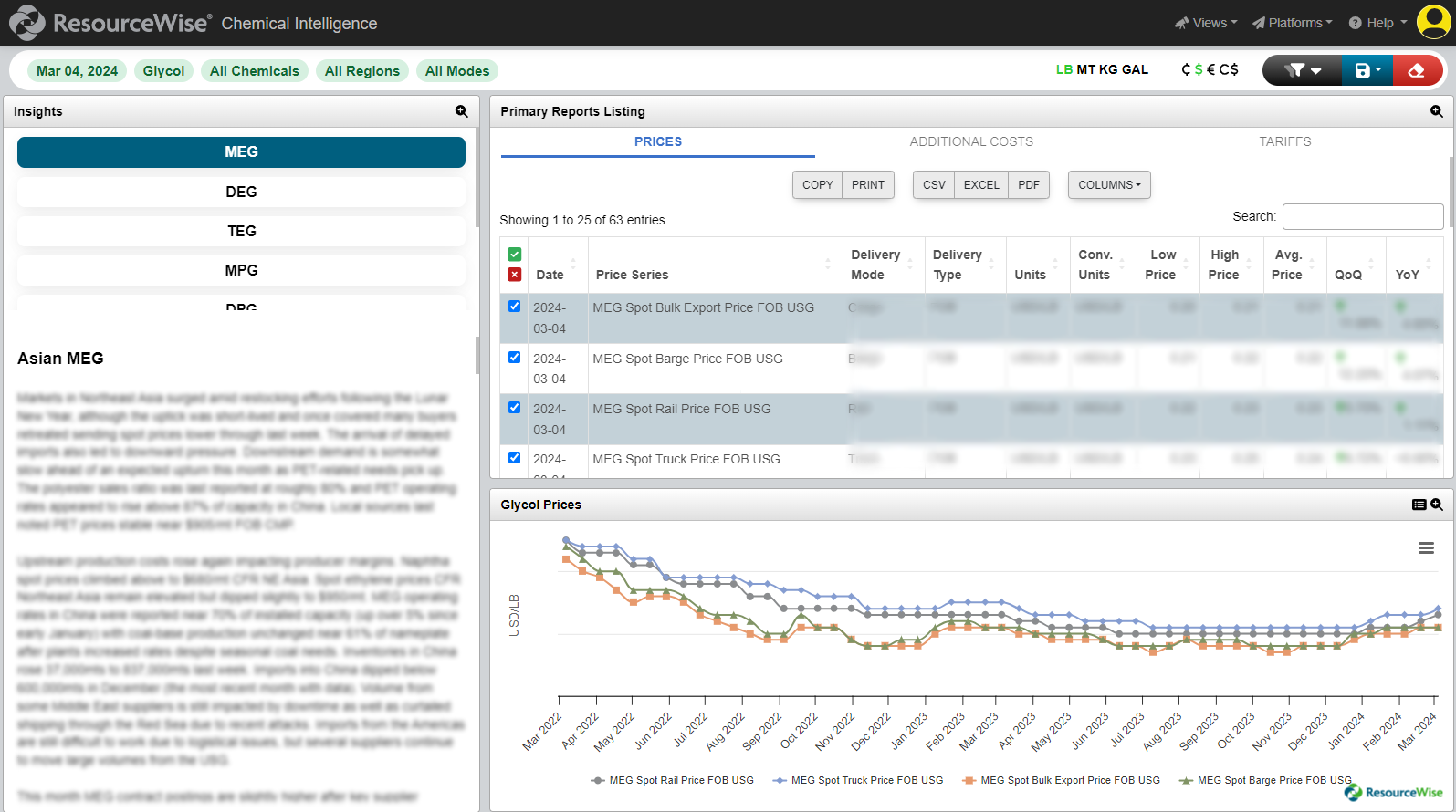
The dynamic changed sharply in Q4. The benchmark fell to 30 cents per pound in November and 28 cents per pound in December. U.S. contract prices for fiber and industrial grades moved down to ~0.18–0.19 cts/lb, and spot export values from the U.S. Gulf dropped into the mid-teens cts/lb. Activity was steady but subdued, with demand below historical norms and only modest support from the antifreeze season. Producers increasingly offered large export parcels—primarily to India and occasionally Latin America—to manage regional length. By year-end, attention had shifted to 2026 contract talks, with buyers targeting ASP deals around $90/mt and preparing for continued length and soft pricing into early 2026.

Diethylene Glycol (DEG)

Firm Early, Oversupplied Quickly

DEG began 2025 on a relatively firm footing before rapidly turning into an oversupply story. By May, contract and spot prices were already under pressure, and large resin consumers reported sales declines of up to 20 percent. Supply availability increased as U.S. Gulf plants completed their returns from early-year outages. MEGlobal reduced its benchmark to 46 cts/lb on May 1 as units such as Lotte Lake Charles and GCGV came back online.

Subdued Activity and Steep Price Cuts

By October, the Americas DEG market was widely described as subdued. Regional availability was ample, and producers struggled to clear surplus volumes against weak downstream demand and limited export opportunities. MEGlobal implemented repeated benchmark reductions—cuts in September and October, followed by a drop to 31 cts/lb effective November 1. Net costs eased substantially, and large-volume barge prices fell below 20 cents per pound (cts/lb) FOB U.S. Gulf, with rail and truck spot deals often in the low-20s cts/lb and occasionally below 20 cts/lb as distributors liquidated their inventory.

Year-End Conditions

In November, the downward pressure continued. Buyers prioritized purchases to meet immediate needs, and prices faced further erosion. Exports to markets such as India were discussed at around $400–410/mt FOB U.S. Gulf, although low overseas pricing and freight frequently limited arbitrage opportunities. Supply across the U.S. Gulf and Canada was normalized, inventories were comfortable, and spot length continued to build. Overall, 2025 was characterized by persistent oversupply, muted downstream consumption, and sharp price erosion—from the mid-40s cents/lb early in the year to the low-30s and sub-20 cents/lb levels by year-end.

Triethylene Glycol (TEG)

Length Overshadows Seasonal Strength

The U.S. TEG market remained structurally long throughout 2025. Although Q4 typically brings stronger gas-dehydration demand, plentiful availability and elevated competition kept the market pressured. By September, reports of deals around 58 cents per pound suggested a possible new price floor heading into final-quarter negotiations.

Muted Seasonal Uptick

By November, market activity remained quiet. Seasonal demand improved gradually as colder weather arrived, but volumes continued to trail typical Q4 levels. Buyers largely purchased on a hand-to-mouth basis, and suppliers adjusted their offers competitively. INEOS Oxide implemented a 5-cts/lb price increase in late October, but additional nominations were limited.

A Competitive, Cautious Close to the Year

In December, the narrative remained consistent: sporadic demand, modest improvement in gas-dehydration applications, and ongoing competitive pressures. Although INEOS and Indorama had initiated 5-cts/lb increases, many market participants questioned the degree to which these increases were accepted. Some producers raised offers only slightly—around 2 cts/lb—to firm the low end of a lightly traded spot market.

Monopropylene Glycol (MPG) and Dipropylene Glycol (DPG)

Comparatively Better Supported

Unlike the ethylene glycols, MPG and DPG remained comparatively better supported through 2025, buoyed by seasonal demand and tightening supply due to planned turnarounds and rationalization. By early September, most producers had implemented contract and spot increases of approximately 5 cents per pound, with an additional increase planned by mid-month. Pre-buying activity temporarily thinned early-September demand, but the market appeared more balanced overall. Propylene continued to set the cost floor, with spot PGP in the 30s cents per pound and August contract settlements at 35.5 cents per pound (PGP) and 34 cents per pound (CGP).

Tightening Supply and Stable Pricing

Supply conditions were shaped by Indorama’s Port Neches PO/MPG turnaround, which began on September 1, Dow’s planned permanent shutdown of its Freeport MPG unit in December, and structurally uneconomic import economics from Thailand and South Korea due to 19 percent and 15 percent tariffs, respectively. By October, the market remained supported, with seasonal demand expected to strengthen through the end of Q4. Earlier price increases were mostly implemented, although the degree of increase varied by account.

Softening but Still Supported into Year-End

In November, the tone softened somewhat but remained fundamentally supported. Distributors reported broader discounting and occasional pushback, while formula-based prices edged lower following a roughly 4-cts/lb drop in October propylene contracts. Seasonal needs for antifreeze, de-icers, and thermal fluids continued to underpin consumption, while demand for coatings and resins lagged. Spot levels moved into the 0.62–0.64 cts/lb range FOB U.S. Gulf for PGI, 0.69–0.73 cts/lb for PGUSP, and the low-$0.90/lb range for DPG.