US Diesel Export Ban Update: G7 Stock Release Eases Risk
 ResourceWise: Oct 5, 2026, 11:42:56 AM
The global pulp, paper, and forest products industry entered 2025 amid continued uncertainty—but exited the year fundamentally reshaped. What unfolded was not a cyclical rebound nor a broad-based downturn, but rather a year of structural adjustment, where regional disparities widened, and strategic clarity mattered more than scale alone.
Across pulp, paper, packaging, and wood products, producers navigated uneven demand, shifting trade flows, regulatory complexity, and persistent overcapacity in key grades. At the same time sustainability investments and traceability/supply chain transparency accelerated, reinforcing a long-term transformation already underway.
The global pulp and paper industry continued to expand in 2025, but the direction of growth increasingly reflected regional strategy rather than uniform demand recovery. Capacity additions were heavily concentrated in Asia-Pacific, while Europe and North America shifted further toward rationalization, restructuring, and selective reinvestment.
These capacity decisions directly reshaped global trade. While total trade volumes increased, competitive advantage moved toward regions with newer assets, lower fiber costs, and improving integration. Producers in Asia-Pacific and Latin America strengthened their position as export suppliers, while many Western producers faced mounting cost pressure and less favorable export economics. As a result, trade growth became increasingly asymmetric, reinforcing the influence of low-cost regions on global pricing and flows.
Trade policy added another layer of volatility. Tariffs, geopolitical tensions, and policy uncertainty remained persistent throughout 2025, often magnifying the impact of relatively small market imbalances. In this environment, trade flows proved highly responsive to policy signals, underscoring that market access can no longer be assumed and must be actively managed.
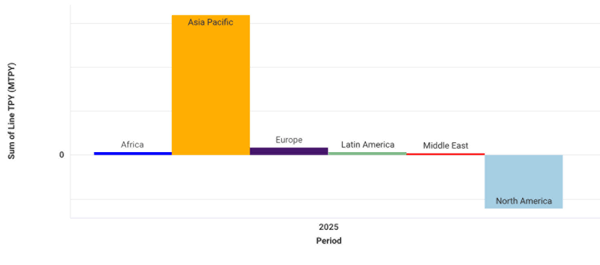
Capacity data from FisherSolve® illustrates this shift clearly. All regions except North America posted year-over-year capacity growth in 2025. North America alone lost nearly 6 million tons of capacity, driven primarily by the U.S. containerboard sector. A prolonged wave of mill closures—many of them containerboard—resulted in a nearly 10% decline in U.S. containerboard capacity versus 2024.
2025 Capacity Change by Region
Source: FisherSolve
Asia Pacific, on the other hand, added nearly 16 million tons of capacity in 2025, reinforcing its growing influence on global supply. In China specifically, the largest capacity additions were concentrated in containerboard and cartonboard, which increased by 6% and 8%, respectively. More notably, China also expanded printing and writing paper capacity by approximately 9%, despite the widespread perception that the grade is in long-term structural decline.
Taken together, these developments suggest that China—and Asia-Pacific more broadly—is investing with a long-term strategic horizon.
China remained a defining force in 2025, both as a market and as a source of global volatility. The country continued adding containerboard capacity despite operating rates well below optimal levels, reinforcing concerns around overcapacity and export pressure.
Excess containerboard capacity in China now exceeds the total capacity of many major producing countries, influencing pricing and margins far beyond Asia. At the same time, China’s push toward greater domestic fiber integration reshaped wood and recovered paper flows, intensifying competition for fiber and altering long-established trade patterns.
These dynamics made differentiation critical. Producers without cost, fiber, or market access advantages felt the pressure most acutely, particularly in commoditized packaging grades.
Cost competitiveness—especially fiber and energy—proved decisive in 2025. Regional disparities widened as producers faced very different operating realities.
Europe remained structurally disadvantaged, with softwood fiber prices significantly higher than those in North America and other regions. Elevated energy costs compounded the challenge, accelerating closures in weaker grades and forcing difficult decisions around compliance investments and long-term viability.
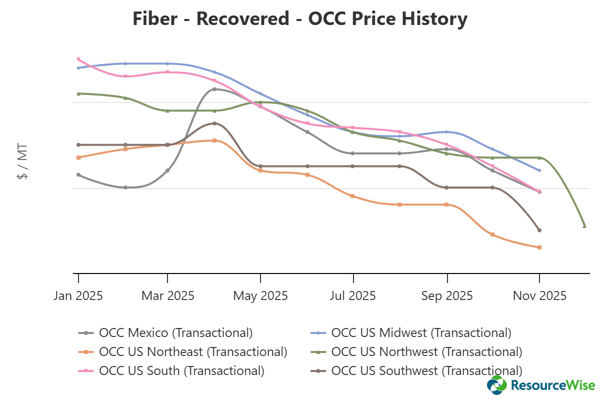
In North America, recycled fiber markets began to soften in May and remained so throughout the rest of the year, easing cost pressure for packaging producers and temporarily improving margins. Latin America, meanwhile, continued to benefit from favorable fiber economics, reinforcing its role as a global low-cost supply base despite trade and demand volatility.
Source: Forestat Global
In 2025, sustainability shifted decisively from aspiration to execution. Customers, regulators, and investors increasingly demanded measurable progress, not just commitments.
European regulation remained front and center. Although the EU Deforestation Regulation (EUDR) received a one-year implementation delay, many producers did not pause their efforts. Investments in digital traceability, supply-chain mapping, and compliance infrastructure continued, reflecting the reality that regulatory readiness is now a prerequisite for market access.
Extended producer responsibility (EPR) frameworks and packaging regulations further reinforced the trend toward fiber-based solutions. “Paperization” continued to gain traction as brands sought alternatives to plastic packaging, providing a meaningful—but uneven—tailwind for paper-based packaging demand.
At the same time, decarbonization efforts became more tangible. Pulp mill carbon capture projects advanced from concept to execution in several regions, signaling that emissions reduction is increasingly tied to capital deployment and long-term competitiveness.
While uncertainty persisted, 2025 was also a year of decisive action. Across regions, producers accelerated investment in assets positioned for long-term relevance while simultaneously exiting structurally challenged segments.
In North America, consolidation and capital deployment reshaped the competitive landscape. High-profile acquisitions strengthened packaging portfolios, while large-scale reinvestment in core assets—such as Pratt Industries’ multi-billion-dollar program to build and modernize recycled containerboard mills across the U.S.—underscored continued confidence in long-term recycled fiber and containerboard demand, even as older, less competitive mills were retired.
Asia-Pacific continued to pursue modernization, automation, and sustainability upgrades, particularly in energy efficiency and biomass utilization. Latin America advanced several large-scale projects, reinforcing its role as a growth and export-oriented region despite near-term demand softness.
The result was a year defined less by incremental adjustment and more by decisive portfolio action. Across the industry—especially in the U.S.—companies accelerated mill closures and consolidation to realign capacity with long-term demand and cost realities. Key examples include:
Above all, 2025 made one reality unmistakably clear: the pulp, paper, and forest products industry is no longer a single global market moving in unison. It is a collection of interconnected regional systems, where success depends on fiber access, cost structure, regulatory readiness, and strategic focus.
Producers that entered the year with advantaged assets, disciplined capital allocation, and clear sustainability pathways strengthened their positions. Those without these advantages faced mounting pressure to adapt—or exit.
As the industry moves into 2026, several forces will continue to shape outcomes: persistent overcapacity in key grades, evolving trade policy, rising regulatory expectations, and the ongoing shift toward packaging and sustainable materials.
The companies best positioned for the future will be those that view 2025 not as a year to endure, but as a turning point—one that clarified where to invest, where to compete, and where to step away.
Stay ahead of 2026's evolving dynamics with ongoing industry analysis, outlooks, and data-driven insights delivered through our newsletter.

 ResourceWise: Oct 5, 2026, 11:42:56 AM
 Jennifer Hawkins: Oct 2, 2026, 9:29:05 AM

ResourceWise : Jan 12, 2026, 9:00:02 AM
Each year, ResourceWise publishes a set of predictions outlining how we expect the forest products industry to evolve over the coming year. As we do...

The pulp, paper, and forest products industry endured another year of uncertainty and significant change in 2025. From new tariffs and widespread...
The forest products industries faced a year of significant change in 2024, marked by shifting market dynamics and unexpected challenges. From...