 Javier Rivera
US Diesel Export Ban Update: G7 Stock Release Eases Risk
 ResourceWise: Oct 5, 2026, 11:42:56 AM
Global overcapacity has long shaped the polyester value chain. In recent years, capacity expansions—led primarily by China but not limited to it—have continued to outpace slowing demand growth. The result is significant global oversupply across PTA, MEG, PIA, and PET, driving persistently low operating rates and compressed margins in every major region.
With end-use demand now growing broadly in line with GDP—and with clear regional differences—markets are increasingly turning to rationalization as the only viable path to restore balance.
Product spreads—which should cover conversion costs and generate margin—have steadily declined across PX, PTA, MEG, and PET over the past two decades. Even with efficiency improvements, current spreads imply unsustainable or non-existent contribution margins throughout the chain. This pattern holds not only in Asia but also in non-Asian markets.
Asia’s competitive advantage, particularly China’s, continues to spill over into other regions. The pricing pressure generated by highly integrated, low-cost Chinese production has contributed directly to unsustainably low margins in Europe, North America, and elsewhere.
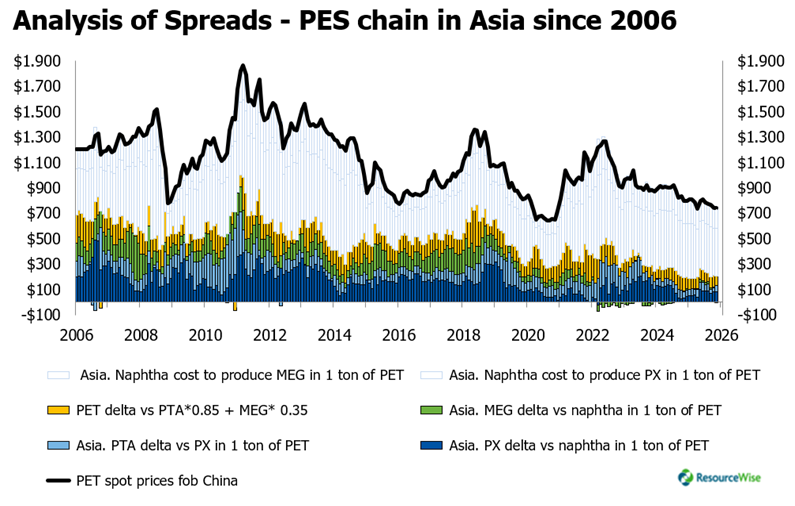
Source: OrbiChem360, ResourceWise
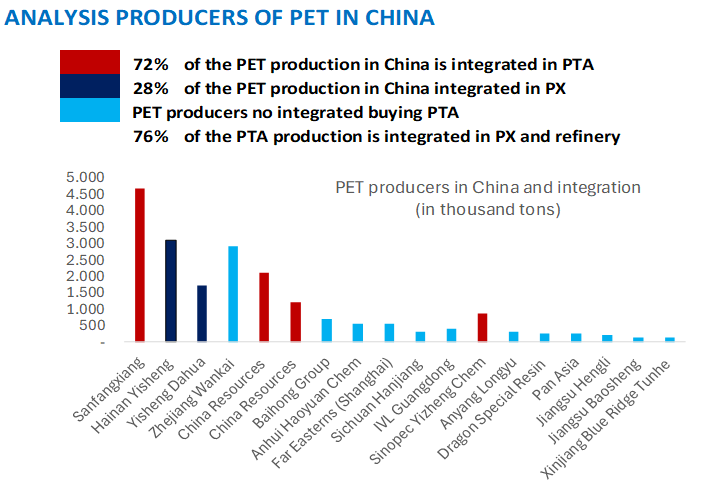
China's push for self-sufficiency in polyester raw materials accelerated massive investment in PTA and PET, leaving the country with substantial overcapacity and a clear net export position. High levels of integration—from textiles to refineries—combined with large-scale production, have created highly competitive cost conditions that weigh on both domestic prices and global export markets.
Global PET nameplate capacity is projected to reach approximately 43 million tons by 2025, with China accounting for around half. A significant portion of this capacity is controlled by highly integrated producers.
After adding 4.2 million tons of PET capacity in 2024 and another ~2.0 million tons in 2025, China's rapid build-out is beginning to slow. Only a few new projects remain on the slate for 2026 and beyond, signaling the end of the 2023–2025 expansion wave.
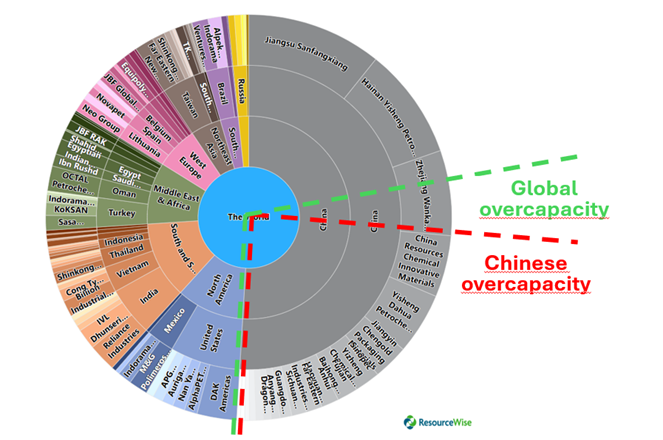
Source: OrbiChem360, ResourceWise
China's PET export volumes continue to rise, up ~14% year-to-date in 2025 to around 5.3 million tons. Producers expect exports to remain resilient due to competitive pricing and steady demand in emerging markets, although margins remain under pressure as suppliers battle for a global share. These exports are concentrated in regions with limited local PET production or without trade barriers.
Source: OrbiChem360, ResourceWise
China's cost advantage is driving increased protectionism and accelerating rationalization in other regions.
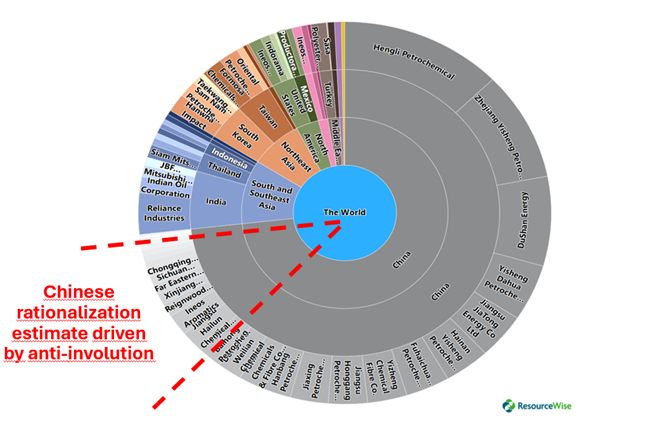
On October 28, 2025, China's industry ministry met with petrochemical producers to reinforce "anti-involution" measures aimed at reducing overcapacity and curbing destructive price competition.
The policy promotes supply discipline, consolidation, and the phase-out of inefficient capacity. In petrochemicals, it includes closer government-industry coordination and product-specific interventions that may support improved spreads and higher operating rates in the coming months.
The local EO/glycol industry has been operating at roughly 65% capacity in 2025 due to poor economics. While no formal capacity-cut target has been announced, market expectations indicate approximately 10–12% PTA capacity rationalization, primarily involving older, high-cost assets. China currently accounts for over 70% of the global PTA capacity.
Source: OrbiChem360, ResourceWise
Rationalization is extending across Asia outside China:
In Taiwan, Lealea Enterprise suspended its 100 ktpa bottle-grade PET line in October 2025 with no restart timeline.
In Korea, Lotte Chemical has reduced PET capacity from 240 ktpa to 110 ktpa since April 2025, a cut widely viewed as structural.
Rationalization is not limited to PET. PTA and MEG producers are also tightening capacity after years of heavy expansions, particularly PTA in China and MEG in both China and the US.
In both Europe and North America, demand for PET-related products is broadly stable, with only marginal growth due to shifting consumption habits, inflationary pressures, and macroeconomic factors. Virgin PET demand has increasingly been displaced by the growing use of R-PET.
Regional producers are under strain from exceptionally high PET import volumes. Import parity remains low due to competitive Asian and Middle Eastern supply, lower freight costs, and favorable exchange rates.
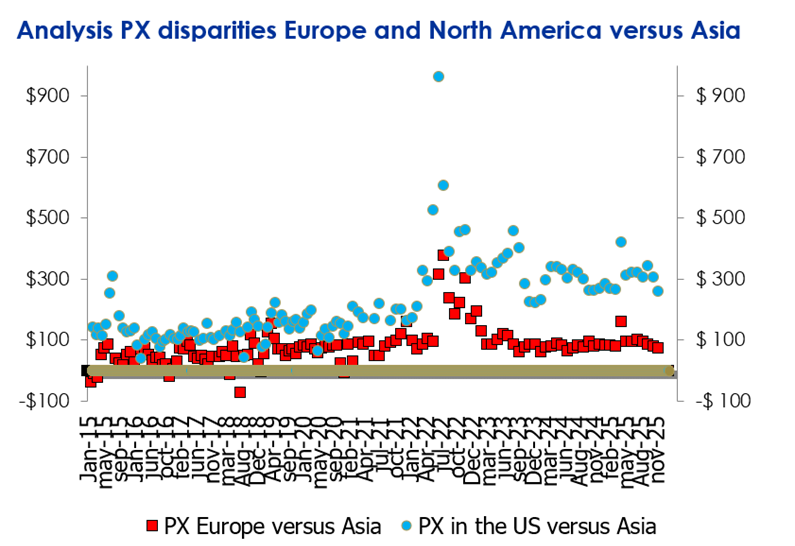
Cost disadvantages are also significant. Large disparities exist between local PX contract prices and Asian PX spot values, which increase PTA/PET production costs in Europe and North America. Monthly contract pricing in these regions further limits the ability to react to volatility in import markets.
Protectionist measures—including anti-dumping actions and tariffs—are now key variables determining operating rates and the survivability of upstream and downstream assets.
Source: OrbiChem360, ResourceWise
US PX supply remains partly opportunistic due to refinery switching between fuels and aromatics. As PX settlements track gasoline-related values, US PX prices tend to clear above those in Asia due to different fundamentals.
US PET producers are actively defending the domestic sector. PET codes 390761 and 390769 were excluded from Annex II, and further trade safeguards are under consideration.
Existing tariffs and trade measures are expected to reshape regional trade patterns in 2026, potentially lifting US production.
Additional developments include:
PTA: Indorama discontinued PTA operations in Canada in September 2024.
PET: Alpek halted PET and R-PET production at Cedar Creek in July 2025.
MEG: Despite cost advantages, US EO/glycol producers face weak growth, low profitability, high costs, declining exports, and tariffs affecting shipments to China. Dow has rationalized Seadrift glycols; Shell is reducing chemical exposure; further curtailments are possible.
PIA: INEOS will not run US PIA production in 2026, making Indorama Spain the only non-Asia PIA supplier.
The long-planned PTA/PET Corpus Christi joint venture remains on hold.
Even with high utilization rates, the US still requires ~1 million tons of PET imports (390761 and 390769, including R-PET). However, volumes, pricing, and origins are expected to shift significantly through late 2025 and 2026.
Europe continues to face a combination of high PX, MEG, and PIA costs relative to Asia, coupled with elevated energy prices. These factors have eroded the competitiveness of PTA/PET.
The region went through heavy rationalization in 2023–2024, including closures at:
Oxxynova DMT (Germany)
Artlant PTA (Portugal)
INEOS' smaller PTA line (Belgium)
Indorama's PTA/PET site in Rotterdam
Despite improvements—narrower PX gaps and lower energy prices—PET spreads and volumes have remained weak.
Europe's monthly PX/feedstock settlements limit responsiveness to import volatility, while imports continue to enjoy structural back-to-back cost advantages.
Additional developments include:
Plastiverd halted PET production in Spain as of the end of November 2025.
Novapet’s second PET line in Spain remains offline until structural market conditions improve.
Anti-dumping cases on PTA (Korea and Mexico) and revised duties on US/Saudi MEG add cost uncertainty.
An EC investigation into Vietnamese PET imports is underway, with a decision expected in January 2026.
Market talk suggests possible EO/glycol exits (e.g., Clariant) and continued low profitability for remaining players.
The only non-Asia PIA producer in the region is running at low rates due to competition from Asia.
Trade flows are shifting further as PET faces US tariffs and as new free-trade agreements come under discussion.
At the start of 2026, many structural issues remain unresolved. Supply-side actions—not demand—are expected to be the decisive force shaping product balances and regional price dynamics.
Key factors to watch include:
Rising protectionism
Free-trade agreements under negotiation
Pace and extent of rationalization across regions
Changing trade flows and supply-chain configurations
Geopolitical uncertainty
The shared need across producers to restore profitability
These elements will influence the polyester chain unevenly across upstream and downstream segments—and across regions—as the industry works to stabilize a market burdened by years of oversupply.
 ResourceWise: Oct 5, 2026, 11:42:56 AM
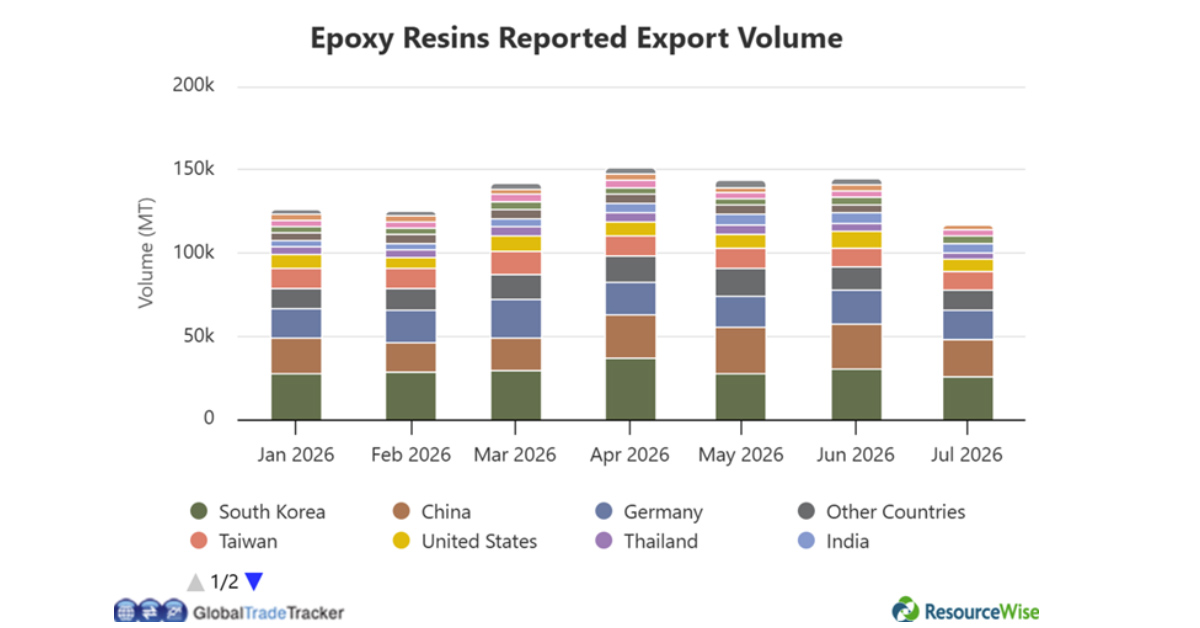
 Jennifer Hawkins: Oct 2, 2026, 9:29:05 AM
 Sam Uctas : Dec 15, 2025, 9:31:07 AM
The global UPR market in 2025 was characterized by subdued demand, declining feedstock costs, and increasing competitive intensity. Across North...
 Rachel Uctas : Dec 5, 2025, 5:16:53 PM
In 2025, the global plasticizer market has been squeezed by weak macroeconomic conditions, soft construction demand, and shifting trade barriers....

Jennifer Hawkins : Jan 16, 2026, 6:00:00 AM
Europe: A Year Defined by Oversupply, Trade Shifts, and Persistent Weakness The year opened with cautious optimism among European epoxy resin...