
 Marko Summanen
New IRS 45Z Guidance Tightens Link Between Feedstocks and Biofuel Economics
 ResourceWise: Oct 12, 2026, 2:25:00 PM

UPM and Sappi have signed a non-binding letter of intent to form a graphic paper joint venture, combining UPM Communication Papers with Sappi’s European graphic paper business. The proposed entity would be owned 50/50 by UPM and Sappi and operate as an independent company responsible for its own operations and strategic decisions within agreed shareholder boundaries.
A major goal of this merger, as pointed out in the press release, is “securing long-term resilience and sustainability.”
But what could this mean for the European paper market?
Historically, UPM and Sappi competed heavily, particularly in coated grades. Pricing considerations was often secondary to maintaining volume, and spot market competition occasionally pushed prices downward.
In this context, the proposed joint venture represents a significant structural shift.
This JV could be a much-needed development to secure the European paper industry's competitiveness, especially given the industry's scattered ownership structure. Without consolidation, the European paper industry risks slowly shrinking itself through fragmentation and chronic overcapacity.
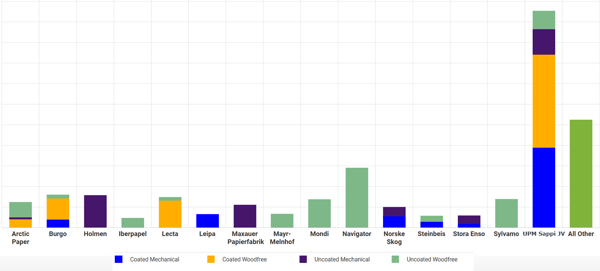
The chart below illustrates the relative scale of European graphic paper capacity by company and grade, highlighting the size of the potential UPM–Sappi joint venture within the broader competitive landscape.
Projected European Graphic Paper Capacity After Joint Venture
Source: FisherSolve
This joint venture will enter a market facing significant structural pressures:
In short, the JV must operate in a structurally declining market while managing rising costs and increasing global competition.
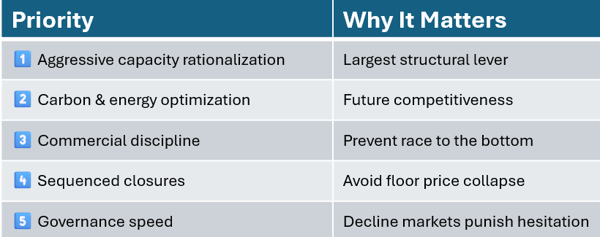
To become stronger than its individual parts, the JV must deliver on five critical priorities:
A unified commercial organization could create immediate opportunities and improvements:
When any joint venture occurs, the most important decisions involve which assets remain competitive and which do not.
Portfolios should prioritize machines that offer:
At the same time, companies may consider exiting assets that are:
Benchmarking tools, such as FisherSolve’s M&A scenario analysis, allow industry professionals to simulate the effects of company mergers.
By merging assets virtually, users can analyze:
In soft market conditions, reducing capacity can allow market prices to temporarily decline further.
This happens because when prices approach the cost floor, the highest-cost producers begin exiting the market, effectively lowering the floor price.
This situation can be overwhelming for high-cost mills that cannot boost their competitiveness through investments, leading to additional closures across the competitive asset base.
Some mills already face difficulties because they lack viable energy solutions—either low-carbon fuels are unavailable or the necessary investments cannot be justified. Specifically, weak sites with no biomass access, district heating, or feasible electrification are increasingly at existential risk.
Today, the industry faces an additional challenge in becoming truly competitive: decarbonization. Carbon emissions are increasingly becoming a second dimension of the cost curve.
Regardless of input costs, maintaining a low CO2 footprint is essential to remain competitive within the peer group. This challenge becomes even more severe when the energy transition cannot be solved economically.
A difference of nearly one ton of CO2 per ton of paper can translate into approximately €100 per ton in additional cost. This difference is significant in an industry where EBITA margins are often below 10%.
The new JV will evaluate its assets as a single portfolio, which fundamentally changes the perspective.
Fiber sourcing is a major cost driver, and because the partners come from very different starting points, this shift will influence which mills appear more or less attractive than before. As costs and synergies are reassessed from a unified viewpoint, some mills may lose competitiveness while others gain it.
A key strategic question will be how vertical integration influences asset competitiveness.
UPM brings substantial fiber security to the equation:
This provides strong fiber security and cost stability.
Whether the JV can leverage this advantage across the combined asset base may become one of the most important strategic questions moving forward.
This ultimately determines:
Another strategic question concerns the potential future role of certain graphic paper machines.
Both UPM and Sappi have established positions in flexible packaging and specialty paper markets, and some of the machines currently producing graphic grades already have the technical capability to produce barrier or flexible packaging papers.
At the same time, regulatory pressure to reduce plastic packaging and increase the use of fiber-based alternatives could create new demand for these grades.
This raises an important strategic question for the joint venture:
Could regulatory and market developments enable some graphic machines to transition into long-term sustainable packaging assets?
However, such a shift would also introduce strategic complexity. Expanding packaging production within the joint venture could potentially overlap with UPM Specialty Papers and Sappi’s existing packaging businesses.
The challenge, therefore, becomes balancing new growth opportunities with portfolio alignment across the parent companies.
The joint venture’s greatest structural advantage may come from the ability to evaluate its mills as a single combined asset portfolio. This allows the new entity to improve competitiveness primarily through portfolio optimization, rather than through significant new capital investment. By closing weaker or overlapping assets, the JV could improve its cost position relatively quickly.
Competitors may face more difficult choices. Without the same scale advantages, they may need to:
In some segments, particularly coated grades, consolidation opportunities may already be limited. However, the move could potentially trigger additional strategic discussions among producers in adjacent grades, including uncoated woodfree.
This UPM and Sappi joint venture will not be judged on the short- or even medium-term growth. It will be judged on:
If executed decisively, this JV could define the European graphic paper market. If execution is slow, it risks becoming simply a larger version of today’s structural problem.
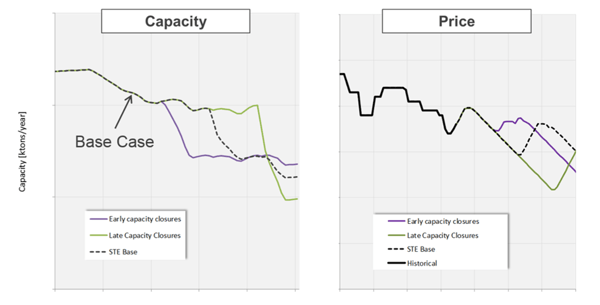
Determining how much capacity must exit the market to restore structural balance will be one of the most critical decisions the new JV will face.
Together with our partner STE Analytics, ResourceWise has developed advanced system-dynamic models that are back-tested against historical data to replicate how the market behaves under different conditions. These models allow us to understand not only how the market is likely to react, but also the consequences that each strategic decision may trigger once implemented.
The example simulation below illustrates alternative capacity-adjustment scenarios and the impact of timing those adjustments.
This type of modeling provides a foundation for well-justified, data-driven strategic decisions.
ResourceWise-STE Market Model Scenario for Capacity vs Price
As the European graphic paper market continues to evolve, strategic decisions around capacity, energy transition, and asset competitiveness will only become more complex. At ResourceWise, our platforms help industry leaders simulate consolidation scenarios, evaluate mill competitiveness, and understand the potential impact of strategic decisions before they are implemented. In a market defined by structural decline and rising cost pressures, data-driven insight is becoming the most important competitive advantage.
To learn more, check out our solutions page.

 ResourceWise: Oct 12, 2026, 2:25:00 PM
 ResourceWise: Oct 9, 2026, 9:12:17 AM
 ResourceWise: Oct 7, 2026, 8:57:37 AM
Stuart Sharp : Mar 30, 2022, 12:00:00 AM
Let’s take a very simplified and quick look around the Pulp World. Cellulosic pulps are comprised of basically the same materials, cellulose...
 Matt Elhardt : Nov 1, 2023, 12:00:00 AM
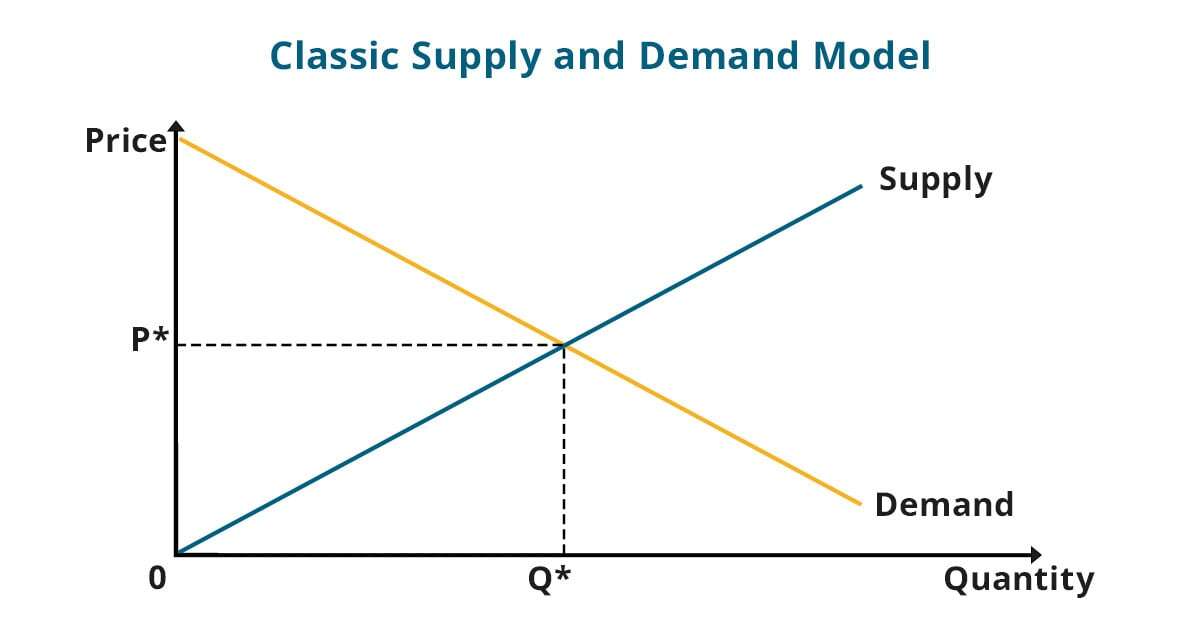
Economic fundamental principles assert that prices are determined by the point at which supply and demand intersect. This theory suggests that by...
Rajat Sarkar : Jul 15, 2024, 12:00:00 AM
India's pulp and paper market is currently experiencing a significant transformation fueled by a mix of economic, demographic, and technological...