
 Rachel Uctas
New IRS 45Z Guidance Tightens Link Between Feedstocks and Biofuel Economics
 ResourceWise: Oct 12, 2026, 2:25:00 PM

In 2025, the global plasticizer market has been squeezed by weak macroeconomic conditions, soft construction demand, and shifting trade barriers. U.S. tariff uncertainty has disrupted traditional trade flows and planning cycles, while shifting tariffs and antidumping duties (ADDs) have reshaped regional competitiveness.
European producers face mounting pressure from lower-cost imports, particularly in dioctyl terephthalate (DOTP) and trioctyl trimellitate (TOTM), as the market enters 2026 with an ample supply, flat demand, and a focus on cost and portfolio resilience rather than volume growth.
U.S. plasticizer demand has been flat to weak this year, with high interest rates and a subdued construction sector capping growth even before reciprocal tariffs took effect.
DOTP prices have remained flat to soft despite ADDs in Turkey, Malaysia, Taiwan, and Poland; imports have declined, but domestic producers have so far prioritized market share over expanding margins in a weak demand environment.
Diisononyl phthalate (DINP) has seen a degree of price erosion even as tariffs on imports hit Asian suppliers and Evonik Oxeno, while domestic producer ExxonMobil has gained some market share; competitive pricing could well persist in 2026 in a structurally import-dependent market as participants aim to retain and grow volume.
Diisodecyl phthalate (DIDP) and di(2-propylheptyl) phthalate (DPHP) have been comparatively stable, supported by wire-and-cable demand linked to data center growth, though some large projects in green energy and electrification have been canceled.
TOTM prices surged early in the year due to a tight global trimellitic anhydride (TMA) supply, then slumped as Asian TMA prices plummeted. Prices are expected to remain stable to soft now that TMA availability has improved.
Europe’s plasticizer sector has mirrored the broader chemical downturn, with weak construction and lackluster automotive demand keeping consumption under pressure.
In DOTP, European producers face aggressive low-cost competition from Turkey and Asia; Polish output is squeezed by cheap imports and the loss of U.S. export opportunities after ADDs, while Chinese DOTP is emerging and is likely to grow in 2026.
DINP prices have softened amid abundant supply, boosted by new capacity at Deza, while EU exporters such as Evonik Oxeno struggle with a 15 percent U.S. tariff that is set to keep the U.S. market challenging next year.
DPHP and DIDP demand has been largely flat, with no clear shift in the European supply–demand balance, and a U.S. investigation into DPHP tariff classification has the potential to impact trade flows in 2026.
TOTM has been the most volatile European plasticizer, with Polynt initially benefiting from high TMA and TOTM prices before being forced into sharp price cuts as Asian TMA and imported TOTM values declined. Chinese and South Korean imports are likely to cap European prices in 2026, while Chinese TMA expansions indicate stable-to-soft feedstock costs.
From January to November 2025, China's dioctyl phthalate (DOP), DOTP, and DINP markets cycled through brief restocking rallies followed by persistent price erosion, closely tracking volatile 2-ethylhexanol (2-EH) feedstock costs. DOP prices fell by RMB 1,700–1,750 per ton over the period, with DOTP and DINP following a similar path, as oversupply and weak downstream demand—especially from construction-related polyvinyl chloride (PVC) products—kept sentiment bearish.
U.S. tariff shifts disrupted the exports of PVC end products, such as gloves, toys, and flooring, triggering order swings around tariff changes rather than structural demand improvements. Operating rates at plasticizer plants were frequently adjusted, but overall availability remained comfortable, driving higher exports. DOP imports fell 42 percent year-over-year in January–September 2025, while exports rose 35 percent over the same period.
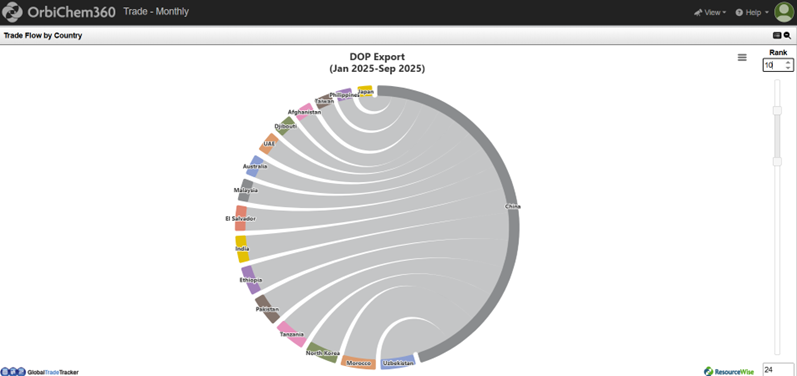
China Dioctyl Phthalate (DOP) Export Destinations and Trade Flows, January–September 2025; Source: OrbiChem360 Trade Data, ResourceWise
Market sentiment remains bearish as we approach the end of 2025. The combination of oversupply and weak domestic demand suggests that prices are likely to remain stable to soft. Prices for DOP, DOTP, and DINP in China are expected to closely follow 2-EH cost movements in 2026. In 2026, China's plasticizer capacity is expected to expand gradually, particularly for DOTP. DOTP will retain its position as the preferred environmentally friendly plasticizer in China and a major export product.
Looking ahead into 2026, the main global themes for plasticizers are expected to persist: structurally weak demand, evolving trade barriers, and ongoing competition from low-cost production hubs. Overall, the global plasticizer market enters 2026 with a cautious outlook, characterized by ample supply, constrained demand, and a continued focus on cost competitiveness and portfolio resilience rather than volume-led growth.
 ResourceWise: Oct 12, 2026, 2:25:00 PM
 ResourceWise: Oct 9, 2026, 9:12:17 AM
 ResourceWise: Oct 7, 2026, 8:57:37 AM
 George West : Jan 15, 2026, 2:24:17 PM
Overview of the 2025 Americas Methanol Market The Americas methanol market in 2025 shifted from a relatively tight, high-priced environment early in...

 Hira Saeed : Jan 16, 2026, 4:00:00 AM
The global chlor-alkali and PVC sectors spent 2025 adjusting to a set of structural pressures that reshaped trade routes, altered operating...

 Jaroslaw Cienkosz : Jan 19, 2026, 4:00:00 AM
Rationalization across major chemical value chains continues at uneven speeds, shaped by demand contraction, persistent oversupply, and regional...