
 Matt Elhardt
Singapore Bio-Bunker Sales Are Down 70%. What's Happening?
 ResourceWise: Sep 8, 2026, 1:59:08 PM

When natural gas prices spike, most market participants ask a familiar question: How much will costs go up?
It's a reasonable instinct, but it misses the bigger picture. The more important question is what these shocks actually do to the market's structure: who moves along the global cost curve, who gains an advantage, and what new opportunities emerge as a result.
In periods of disruption, cost isn't just a number; it's a signal of shifting competitive position.
The war in Iran has driven a sharp increase in European natural gas prices. Because power markets in Europe are tightly linked to gas, electricity costs have risen in tandem. Shortly after the war began, liquified natural gas exports from the Persian Gulf to the EU declined, triggering an immediate spike in pricing.
This dynamic mirrors what occurred during the Russia-Ukraine war and reinforces a critical point: Europe's vulnerability to energy shocks is structural, not cyclical. In this case, Western European gas prices rose more than 60% almost overnight.
So, what does that mean for linerboard cost curves?
At baseline, European and North American mills compete within a relatively tight cost range. Marginal producers define pricing, and regional advantages tend to be modest. This is reflected in the cost curve for linerboard delivered to Southern Europe, where North American mills (green) and European mills (red) are distributed throughout the curve.
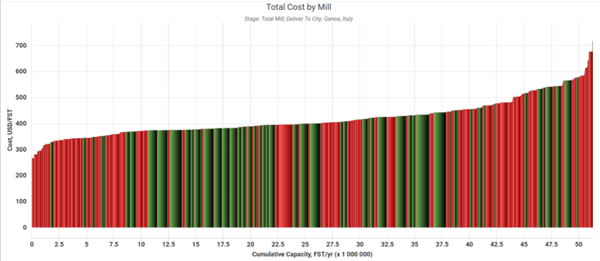
Figure 1: Cost curve for linerboard delivered to Southern Europe, including North American kraft linerboard mills and European recycled and kraft linerboard mills.
Using FisherSolve®, we modeled a 60% increase in both natural gas and power costs across European linerboard producers to understand how the curve would change relative to baseline conditions. This can be done using the "What-If" tool, a powerful way to apply price changes to the cost curve to evaluate how changes could impact the market.
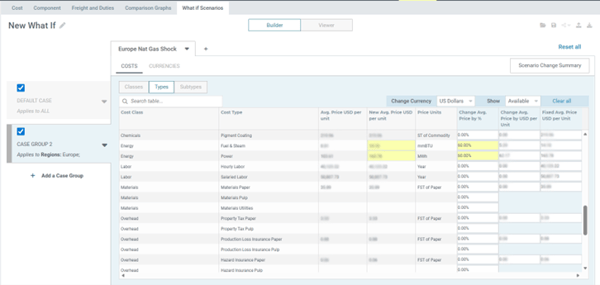
Figure 2: FisherSolve's What-If tool enables rapid application of price changes to generate new cost curve scenarios.
When these energy increases are applied, the cost curve shifts meaningfully. Fourth-quartile costs rise by roughly $80 per short ton (~$90 per metric ton), closely aligning with recent market price announcements.
This isn't coincidence—it's causality.
Energy shocks don't just increase costs; they reset the marginal ton. And when the marginal ton moves, market clearing prices often follow, depending on demand conditions. In that context, recent linerboard price increases from European mills are not surprising, they are a direct outcome of the new cost structure.
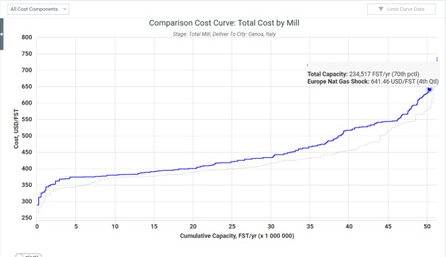
Figure 3: FisherSolve's What-If viewer shows the new cost curve (blue) after applying increases in gas and electricity prices in Europe, compared to the baseline (gray).
The more important story isn't the absolute increase in costs, but the relative shift in competitiveness between EU mills and those in North America (or elsewhere for other grades).
As European mills absorb higher energy costs, they move up the global cost curve. That shift reduces their export competitiveness and creates an immediate opportunity for lower-cost regions—particularly North America.
In practical terms, this begins to play out quickly. North American producers become more competitive into Europe, especially for marginal or spot tons. As exports become more attractive, trade flows start to adjust. Over time, that can tighten US domestic markets as supply is reallocated toward higher-margin opportunities abroad.
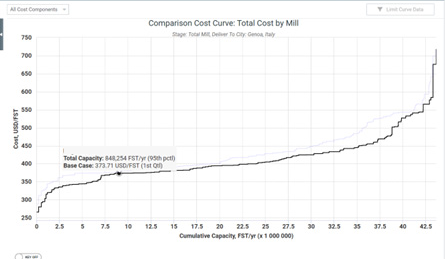
Figure 4: US mills gain relative competitiveness in Europe as energy-driven cost increases remain concentrated in the EU.
What starts as an energy shock in one region quickly becomes a global market event. Costs rise locally, but competitiveness shifts globally—and that is where the real impact is felt.
Most organizations react to price announcements after they happen. By then, the market has already begun to move.
Leaders take a different approach. They model the shift before it hits—and act on it.
With FisherSolve, you can quantify how input cost shocks ripple across the global cost curve, identify which assets gain or lose competitiveness, and anticipate trade flow changes before they materialize. That visibility allows you to move ahead of the market rather than respond to it.
Because in volatile markets, advantage doesn't simply go to the lowest-cost-producer—it goes to the organization that understands how the curve is about to move.
To see how FisherSolve can help you model market shifts and uncover competitive opportunities, visit or FisherSolve solutions page.

If you want to continue the discussion on cost pressures shaping the European pulp and paper market—including energy, chemicals, and regulatory dynamics—join our upcoming webinar, Navigating Cost Pressures: Energy, Fiber & Chemicals in the European Pulp & Paper Market, on April 9 at 10:00 AM EDT.

 ResourceWise: Sep 8, 2026, 1:59:08 PM
 ResourceWise: Sep 8, 2026, 8:57:11 AM
 ResourceWise: Sep 4, 2026, 8:59:42 AM
 Matt Elhardt : Nov 1, 2023, 12:00:00 AM
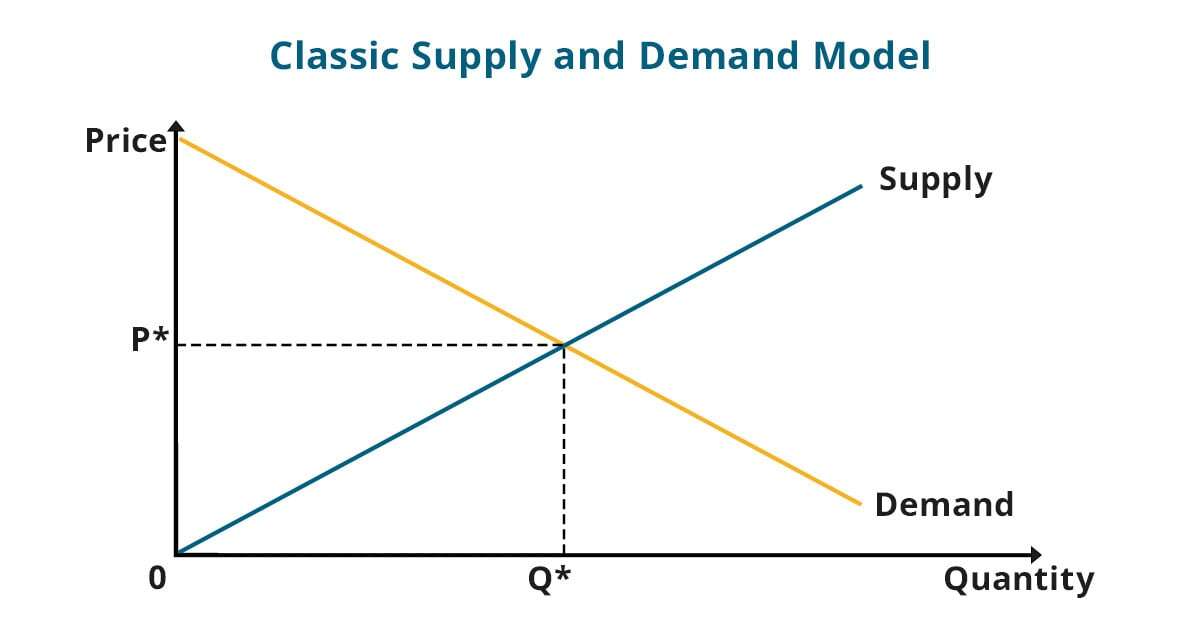
Economic fundamental principles assert that prices are determined by the point at which supply and demand intersect. This theory suggests that by...
ResourceWise : Apr 24, 2026, 12:04:55 PM
The pulp and paper industry has seen several notable announcements in April 2026. Taken together, they point to a few important themes: continued...

ResourceWise : Jun 3, 2025, 12:22:04 PM
From inflation and freight disruptions to regulatory overhauls and billion-dollar mergers, the first quarter of 2025 has already proven to be a...