US Diesel Export Ban Update: G7 Stock Release Eases Risk
 ResourceWise: Oct 5, 2026, 11:42:56 AM
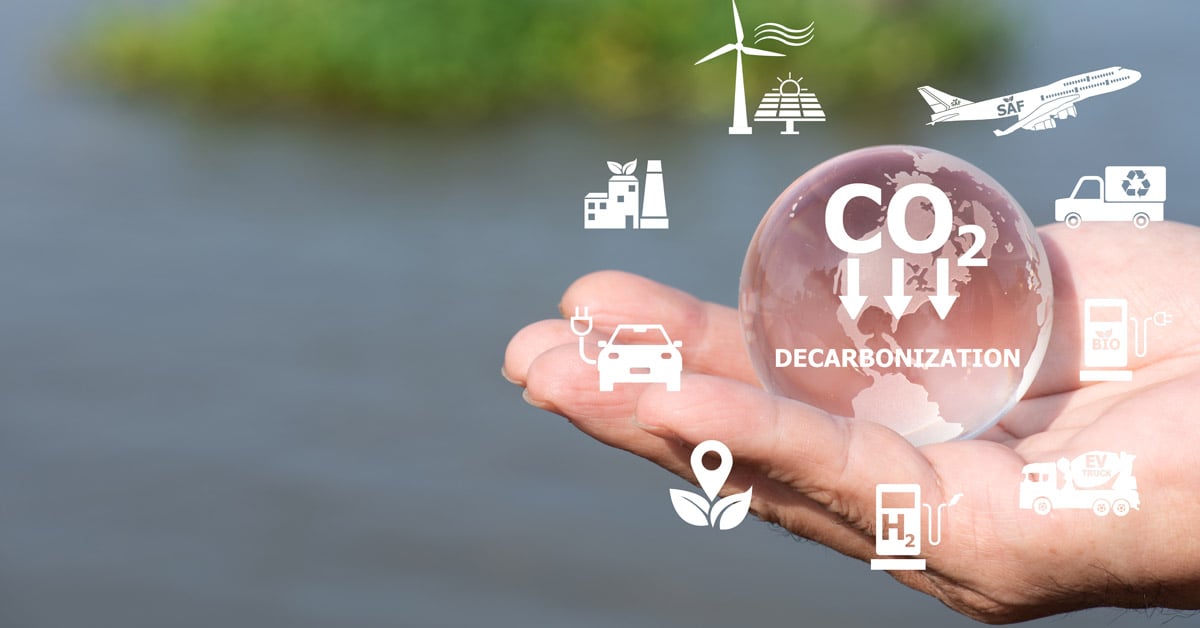
The path to net-zero emissions is clear in principle but increasingly complex in practice.
Global targets are ambitious while policies are tightening. Technologies are advancing rapidly. Yet for many companies, decarbonization remains less a straight line and more a moving target.
The challenge is not a lack of intent. It is navigating a system simultaneously shaped by geopolitics, cost pressures, technological uncertainty, and fragmented supply chains.
Governments and international bodies have laid out aggressive timelines for emissions reductions. Many economies have set targets for significant cuts by 2030 and for full net zero by 2050.
But the real challenge lies in the details in between: the operational and strategic decisions required to turn ambition into measurable progress.
Decarbonization is no longer about setting goals. It is about building and executing a viable pathway.
Today, several factors directly impact the move to decarbonize.
Recent geopolitical disruptions, particularly conflicts affecting global energy markets, are complicating decarbonization strategies.
Energy security is once again competing with sustainability goals:
This creates a paradox: the urgency to decarbonize is increasing, while the conditions to do so are becoming less stable.
For businesses, this means planning for a future where:
Of course, planning for uncertainty presents its own set of challenges. But understanding that this is the state of the industry can help you set the foundations for responding to change when it occurs.
Read More: Biofuels Markets Find Their Footing Amid Fragile Iran Ceasefire
Decarbonization often requires significant capital investment:
While long-term savings and incentives can offset these costs, the initial financial burden remains a major hurdle. This holds particularly true as we endure ongoing uncertainty in our collective economic conditions.
The reality of decarbonization depends on these factors to move forward. Decisions must be grounded in budgetary and technical feasibility, not just ambition.
Companies must weigh:
In many cases, this slows adoption even when the long-term carbon objective is clear.
From low-carbon fuels to electrification and carbon capture, the range of decarbonization technologies is expanding rapidly.
But this creates its own challenge. Which pathway should you commit to?
Many solutions are…
The result is strategic uncertainty. Companies must make decisions today that will shape operations for decades, often without full visibility into which technologies will dominate.
To navigate this ambiguity, flexibility is critical. Decarbonization plans must be designed to adapt to new developments and breakthroughs, not lock into rigid pathways.
One of the most underestimated challenges in decarbonization lies beyond a company's direct control: its supply chain.
Even if internal operations are optimized, emissions from suppliers and partners can undermine overall progress.
It is important to recognize all of these factors with business associates:
But in reality, this is difficult to achieve:
This creates a structural issue: decarbonization is only as strong as the weakest link in the value chain.
Decarbonization decisions depend on accurate, timely data:
Yet many companies lack clear visibility across these areas.
Success depends on reliable market intelligence to inform strategy and measure progress.
Without it, businesses risk:
In a fast-moving market, information asymmetry becomes a competitive disadvantage.
Even with a clear strategy, implementation remains a major challenge.
Companies often:
The final step, execution, requires:
A plan is only valuable if it can be implemented, tracked, and adjusted over time. Otherwise, how will you know you’re making progress?
Decarbonization is no longer a standalone initiative. It is a system-level transformation that touches every part of a business:
And increasingly, it is influenced by forces outside any single company's control.
The challenges facing decarbonization today are not temporary; they are structural.
Geopolitical instability, cost pressures, evolving technologies, and fragmented supply chains will continue to shape the landscape for years to come.
But within that complexity lies opportunity. Companies that succeed will be those that:
The path to net zero may not be linear. But with the right approach, it is still navigable.

Ready to get started in your own decarbonization planning? Download our eBook, Mapping a Path for Decarbonization, for a practical guide on what you’ll need to succeed in your own carbon transition.
Download the eBook today.

 ResourceWise: Oct 5, 2026, 11:42:56 AM
 Jennifer Hawkins: Oct 2, 2026, 9:29:05 AM
.png)
 Amanda E. Clark : Jul 8, 2026, 9:38:30 AM
Resource industries have always been connected to global markets. For instance, think about a mining company that may buy equipment from one country,...

ResourceWise : Jan 6, 2026, 2:19:00 PM
We all know how quickly the global business landscape is shifting to Environmental, Social, and Governance (ESG) compliance. Even though it’s often...
ResourceWise : May 29, 2026, 9:50:04 AM
ResourceWise recently held a webinar on the biofuels market amid ongoing uncertainty stemming from the War in Iran. During the webinar, Matthew Stone...