4 min read
World Chlor-Alkali Conference Day 1 Debrief: Global Markets Adjust to a More Complex Landscape
Hira Saeed
:
Jun 11, 2026 12:00:00 AM
Day 1 of the World Chlor-Alkali Conference brought together market experts, producers, and industry participants to examine how chlor-alkali, PVC, and caustic soda markets are responding to a changing global landscape.
Throughout the day, discussions pointed to a market no longer simply navigating a short-term downturn. Weak demand in key downstream sectors, regional cost pressures, evolving trade flows, new capacity additions, and geopolitical uncertainty are reshaping how producers, buyers, and investors view the outlook for 2026 and beyond.
The value of the conference was in the breadth of perspectives shared. Sessions covered Europe, the US, China, India, the Middle East, Southeast Asia, and broader global chlor-alkali dynamics, providing attendees with a cross-regional view of how market pressures are evolving and where future opportunities may emerge.
Europe: A Structural Reset, Not a Short-Term Cycle
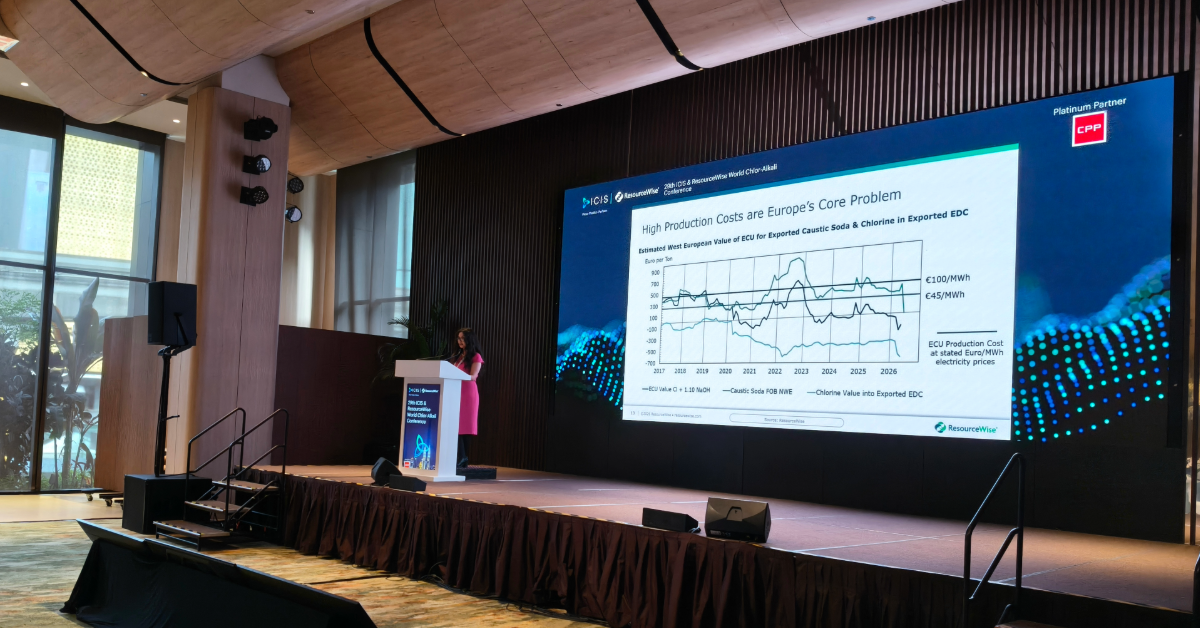
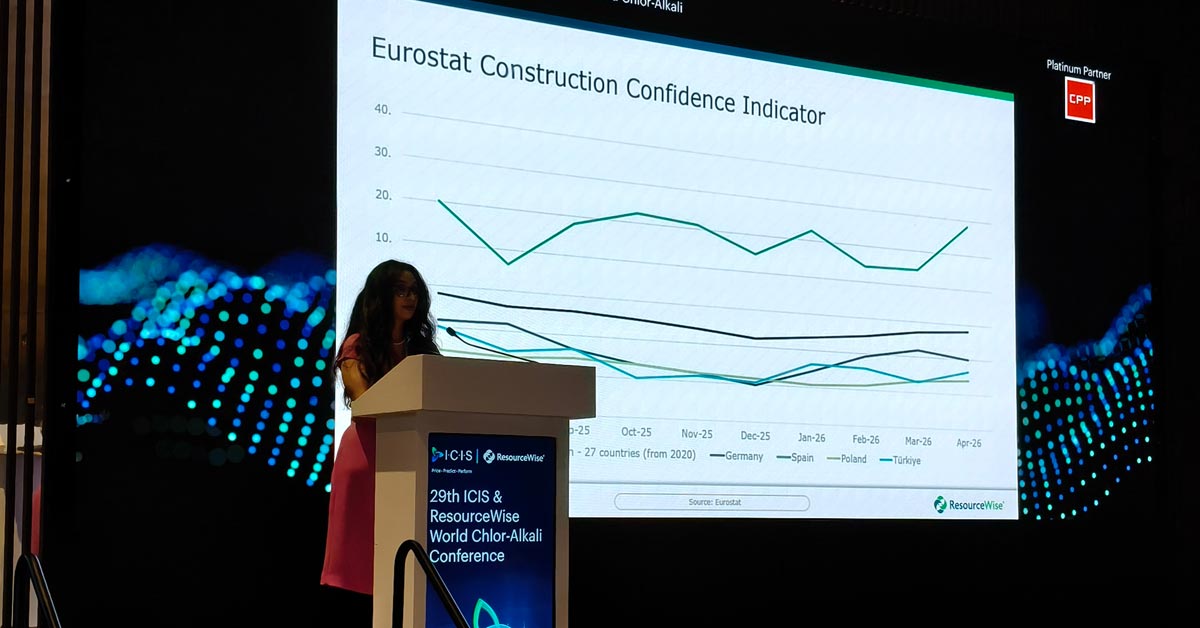
The day began with Hira Saeed, Senior Consultant at ResourceWise, who discussed the major shifts in Europe's chlor-alkali and PVC markets.
Europe remains under pressure from weak construction-led PVC demand, high production costs, and constrained chlor-alkali operating rates. PVC is central to the wider balance because it is a major outlet for chlorine. When PVC demand is weak, chlorine offtake is reduced, limiting chlor-alkali output and constraining caustic soda supply, even when caustic demand itself is relatively stable.
The presentation also highlighted how trade flows, import pressure, and capacity rationalization are changing Europe’s market position. Recent restructuring across the European vinyls and chlor-alkali chain suggests the region is facing a structural adjustment rather than a typical cyclical downturn. Any recovery is likely to depend on stronger construction activity, infrastructure investment, industrial production, and further market rebalancing.
US Market: Housing, Exports, and Market Resilience
Kelly Coutu, Director - PVC at ICIS, discussed the US chlor-alkali market outlook through the lens of housing, construction demand, export competitiveness, and producer resilience.
The session highlighted the importance of domestic demand recovery, energy cost advantages, and the role of US exports in a global market that remains highly competitive. With PVC and chlor-alkali chains closely linked to construction activity and international trade flows, the US outlook remains closely tied to both domestic economic conditions and global demand patterns.
Asia Macro Trends: Economic Shifts and Investment Priorities
Albert Li, Analyst - Asia Chemical at Bloomberg, provided attendees with a broader view of how regional economic trends are shaping the chemical sector across Asia.
Key themes included energy security, investment sentiment, electrification, renewable energy, and the impact of geopolitical uncertainty on feedstock costs and industrial strategy. These wider macro trends are increasingly important for chlor-alkali markets, as they influence cost structures, demand growth, and future investment decisions across the region.
China: Cost Competitiveness and Regional Influence
Lulu Zhao, Consultant at ResourceWise, examined China's competitive position and its influence on the global chlor-alkali market.
China remains a major force in Asian caustic soda and PVC markets, supported by its scale, cost position, and export capability. Low electricity costs continue to provide an important advantage for Chinese chlor-alkali producers, particularly compared with producers in higher-cost regions.
The session also explored how shifts in downstream demand, including alumina and emerging battery-related applications, are shaping the longer-term outlook. As one of Asia's largest and most stable caustic soda suppliers, China's domestic and export pricing remains an important indicator for the wider regional market.
India: A Growing Force in the Asia Pacific
Mayank Sharma, CEO of Grasim Industries Ltd., presented India as one of the most important long-term growth stories in the chlor-alkali sector.
The discussion focused on India's shift from import dependence towards a more structurally significant role in regional supply and demand. Capacity growth, downstream integration, industrialization, and infrastructure development are all expected to influence India’s position in the years ahead.
One of the key themes was the need to balance caustic soda growth with chlorine integration. As India expands its chlor-alkali base, the development of downstream outlets will become increasingly important to long-term market stability.
Middle East: Capacity Growth and Regional Integration
Rajesh Shethia, Managing Director of Hiranyavarnaam Chemicals & Alkalis Pte Ltd, Singapore, discussed the Middle Eastern market in the context of low-cost production, regional integration, and new capacity developments.
Energy cost advantages continue to support the region's competitiveness, while major industrial projects and downstream demand are shaping its future role in global chlor-alkali markets. The session also underlined the importance of understanding how new supply from the Middle East and Asia may be absorbed over the coming years.
Global Chlor-Alkali Landscape: Pressure, Resilience, and Adaptation
Jonathan Chou, Senior Editor at ICIS, focused on resilience amid pressure in the global chlor-alkali landscape.
The session considered the challenges facing PVC and wider chlor-alkali markets, including surplus supply, shifting trade flows, investment uncertainty, and changing regional dynamics. Rather than focusing on a single market, the discussion helped frame the broader forces shaping the global outlook.
A key theme was how producers and buyers are adapting to changing market conditions. With traditional demand drivers under pressure across several regions, the industry is increasingly examining how new applications, trade adjustments, and strategic investment decisions could shape the next phase of growth.
Southeast Asia: Building Beyond Caustic Soda
Guo Zhe, General Manager of PT Bintan Fine Chem Indonesia, discussed Southeast Asia as a region with strong long-term growth potential, supported by population growth, industrialization, and manufacturing investment.
The session highlighted that future development will not only be about producing caustic soda, but about building more complete value chains. Downstream integration, regional competitiveness, and demand growth will all play important roles in shaping the region’s chlor-alkali outlook.
Pulp and Paper: A Key Caustic Soda Demand Driver
Amy Chu, Senior Consultant at ResourceWise, examined the pulp and paper industry and its role as a driver of caustic soda demand.
The session highlighted how regional pulp capacity developments are influencing caustic soda consumption, with Asia Pacific and Latin America expected to play an increasingly important role in future demand growth. While mature markets remain significant, new capacity additions and operating rate trends are changing the regional balance.
Panel Discussion: Geopolitics, Structural Shifts, and Market Adaptation
The day closed with a panel discussion on how chlor-alkali markets are adapting to geopolitical and structural shifts.
The panel brought together Mayank Sharma, CEO of Grasim Industries Ltd.; Rajesh Shethia, Managing Director of Hiranyavarnaam Chemicals & Alkalis Pte Ltd, Singapore; Carol Li, Senior Consultant at ResourceWise; William Bann, Lead Business Manager at ResourceWise; and Kelly Coutu, Director - PVC at ICIS.
The discussion reinforced several of the day's key themes, including feedstock volatility, energy costs, trade disruption, regional competitiveness, and downstream integration. It also gave attendees the opportunity to hear how different parts of the value chain are interpreting current risks and preparing for future market change.
Key Takeaways from Day 1 of the World-Chlor Alkali Conference
Day 1 showed that global chlor-alkali markets are becoming more regionally complex and structurally uneven.
Europe continues to face pressure from weak PVC demand, high costs, and import competition. The US remains closely tied to construction demand and export dynamics. China continues to influence Asian price direction and global trade flows, while India, the Middle East, and Southeast Asia are becoming increasingly important to future supply and demand balances.
Across regions, PVC remains one of the main sources of pressure for the wider chlor-alkali chain, while caustic soda remains tied to chlorine offtake, operating rates, and regional trade flows.
The industry's challenge is no longer only about navigating a weak cycle. It is about adapting to a market in which cost competitiveness, trade policy, downstream integration, and geopolitical risk are becoming more important than ever.
For attendees, Day 1 offered a valuable opportunity to compare regional perspectives, hear directly from market participants, and understand how today's pressures may shape tomorrow's opportunities.
Learn more about the World Chlor-Alkali Conference, jointly hosted by ICIS and ResourceWise.