
 Marko Summanen
Why Are Wood Fiber Costs So High for European Pulp Producers?
 Marko Summanen: Aug 25, 2026, 11:39:58 AM
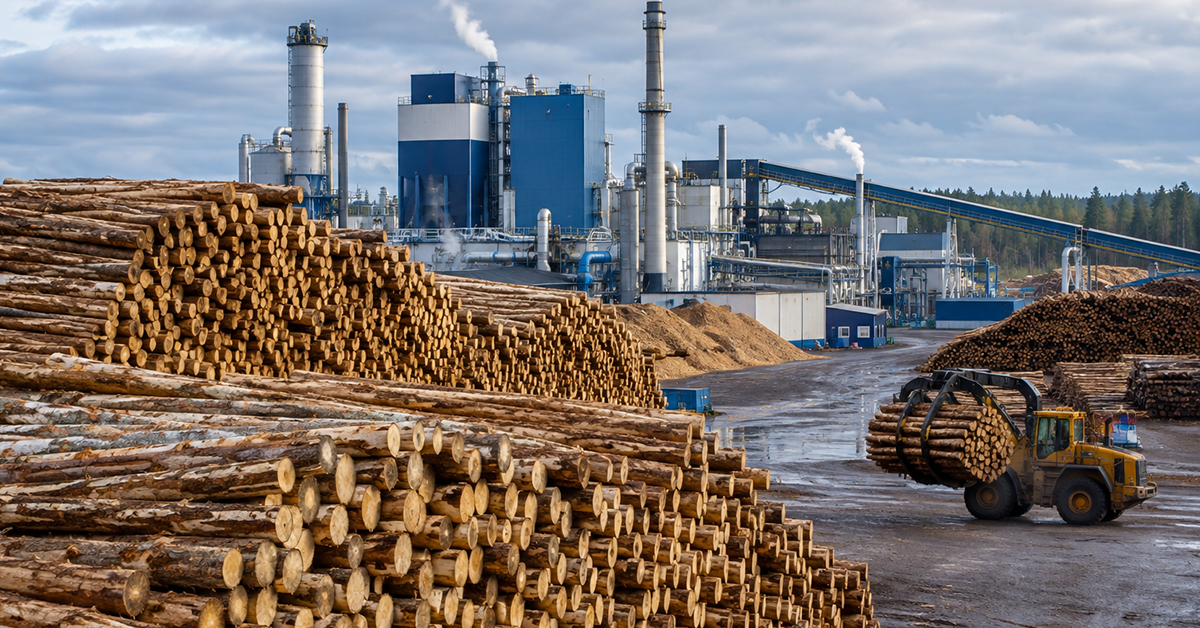
European pulp producers face some of the highest wood fiber costs in the world due to a combination of constrained wood supply, growing competition for forest-based feedstocks, elevated log prices, changing trade flows, and regulatory pressures.
For pulp mills, these conditions have made fiber an increasingly important factor in overall production economics. In several major European pulp-producing countries, wood fiber now represents well over half of manufacturing cash costs—and in some markets, more than 70%.
Understanding what is driving those costs is essential for producers evaluating procurement strategies, mill competitiveness, and future investment.
Wood fiber is the largest component of manufacturing cash costs for many European pulp producers.
ResourceWise's WoodMarket Prices (WMP) data shows that wood fiber accounted for more than 70% of manufacturing cash costs for pulp producers in Austria and Finland in Q4 2025. Those elevated ratios continued into Q1 2026.
Across several major European markets:
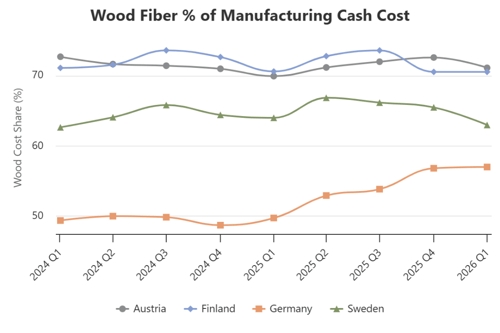
Source: WoodMarket Prices
These percentages vary by mill and product mix. Market pulp production, for example, is particularly exposed to wood fiber costs, while mills producing grades that use more fillers may have a lower percentage of their manufacturing costs tied directly to wood.
Temporary increases in wood availability can also influence these figures. Storm damage and other forest disturbances have periodically increased European wood supply and reduced costs, but those effects are temporary.

Europe's high wood fiber costs are not the result of a single market factor. Instead, several structural pressures are affecting both the availability and price of pulpwood, logs, and wood chips.
Pulp producers increasingly compete for wood with industries outside traditional pulp and paper markets.
Bioenergy, renewable fuels, engineered wood products, and biomaterials all rely on forest-based feedstocks. As these industries grow, more buyers can compete for the same underlying wood resource.
Policy can also influence this competition. Renewable-energy and fuel mandates can create demand for certain forest-derived feedstocks, allowing competing applications to support higher prices even when feedstock costs increase.
At the same time, European pulp producers have less flexibility in some traditional sourcing channels. The loss of Russian wood imports has been particularly important for Baltic and Nordic markets, including Finland, tightening regional supply and increasing dependence on other sources.
European softwood log prices remain substantially above their 2020 levels.
ResourceWise WoodMarket Prices data shows that delivered softwood roundwood prices in Germany during 2025 were approximately 66% higher than in 2020. Finland and Sweden both recorded prices roughly 50% above 2020 levels.
There are signs of stabilization in some individual markets.
Finland's softwood pulp log prices, for example, declined approximately 17% from their Q2 2025 peak. Austria's pulp log prices also stabilized following several quarters of declines.
However, lower prices compared with recent peaks do not necessarily mean a return to historically normal costs.
Other fiber categories remain elevated. Softwood chip prices continued increasing through 2025 in Austria and Germany, while French chip prices flattened in early 2026 but remained at relatively high levels.
Longer-term wood availability is another consideration. Dry summers, high temperatures, and other forest disturbances can affect future conifer supply. Some European forest-products companies are also looking beyond their domestic markets to secure long-term access to wood resources.
European pulp and paper producers operate within an evolving regulatory environment that can affect both manufacturing costs and future wood availability.
Important policies include:
The impact is not limited to direct compliance costs.
Changes to forest-management requirements can influence the amount of wood available for commercial use, while energy and emissions policies affect production economics and competition for forest-based resources.
Proposed changes to ETS benchmarks have also raised concerns about future investment. CEPI estimates that proposed benchmark reductions could reduce annual investment capacity for Europe's pulp and paper industry by approximately €1 billion, potentially affecting investment in mill modernization and decarbonization.
Restoration policies could also reduce the amount of forest available for commercial harvesting over time. If supply becomes more constrained, pulp mills may face additional competition for available wood.
Energy costs influence fiber economics before wood ever reaches a pulp mill.
Higher fuel prices increase the cost of harvesting and transporting wood, while elevated energy and chemical costs add pressure within the mill itself. This means producers can face higher costs across several stages of production simultaneously.
As a result, fiber prices need to be viewed within Europe's broader manufacturing cost environment rather than as an isolated procurement expense.
European wood fiber prices may fluctuate from quarter to quarter, but several structural factors suggest costs are likely to remain elevated relative to historical levels.
These include continued competition from bioenergy and biomaterials, limited growth in available wood supply, regulatory and sustainability requirements, transportation and energy costs, and uncertainty surrounding international fiber trade.
Recycling trends add another dimension to Europe's fiber balance. Policies that encourage greater use of recycled material can increase demand for recovered fiber, but recycling cannot eliminate the need for virgin fiber. Fiber is lost and degraded during repeated recycling cycles, meaning virgin wood fiber remains necessary to maintain the overall fiber system.
If paper and pulp demand strengthens, wood suppliers may respond by increasing harvest activity where possible. However, stronger demand could also intensify competition for an already constrained resource.
For European pulp producers, this means wood procurement will remain an important part of maintaining mill competitiveness.
Producers cannot control many of the structural forces affecting Europe's wood markets, but they can improve how they respond to them.
That starts with understanding how delivered wood costs vary across regions, fiber types, and competing markets. Producers can use regional pricing and supply data to benchmark procurement costs, identify changes in local fiber availability, evaluate alternative sourcing regions, and understand how their fiber position compares with competing mills.
As fiber represents a growing share of manufacturing costs, procurement intelligence becomes increasingly important to broader mill strategy.
For pulp producers, suppliers, and investors, understanding regional fiber availability and delivered wood costs is increasingly important for evaluating competitiveness and making strategic decisions.
Stay informed with the ResourceWise monthly newsletter, featuring expert insights, market analysis, and the latest developments shaping the global forest products industry.

Wood fiber prices are elevated because European pulp producers face constrained supply, competition from other forest-based industries, historically high log prices, reduced flexibility in international sourcing, and regulatory and energy-related pressures.
ResourceWise data shows particularly high wood fiber shares in Austria and Finland, where fiber represented more than 70% of manufacturing cash costs in late 2025. Sweden also remained high at approximately 64–67%.
Some markets have eased from recent peaks, but prices generally remain elevated compared with historical levels. Finland's softwood pulp log prices, for example, declined from their Q2 2025 peak while remaining well above 2020 levels.
Pulp mills and bioenergy producers can compete for overlapping forest resources. Policies supporting renewable energy and fuels can increase demand for forest-based feedstocks, adding competition within regional wood markets.
Recycling can reduce the amount of virgin fiber required for certain paper and packaging products, but it cannot replace virgin fiber entirely. Fibers degrade and are lost through successive recycling cycles, requiring new virgin fiber to enter the system.
Marko Summanen: Aug 25, 2026, 11:39:58 AM

 ResourceWise: Aug 25, 2026, 8:00:03 AM
 ResourceWise: Aug 24, 2026, 8:00:00 AM