
New IRS 45Z Guidance Tightens Link Between Feedstocks and Biofuel Economics
 ResourceWise: Oct 12, 2026, 2:25:00 PM

Despite their tumultuous and tenuous status, the recent outline of peace terms between the United States and Iran has quickly reshaped market expectations. Since March, much of the market has been operating under assumptions tied to tighter fossil-fuel supply risks. Now, a rapid recovery in fossil fuel supplies has become the dominant view.
That shift hit heating oil prices hard. According to a Prima CarbonZero analyst report, heating oil weakened sharply while soybean oil remained steadier, supported by relatively inelastic biofuel demand under this year's fixed RFS (Renewable Fuel Standard) market. As a result, the spread between soybean oil and heating oil widened by more than 20 cents per pound overnight.
For biomass-based diesel producers, the revenue stack is now under pressure as heating oil-linked values move lower. However, mandated demand for feedstocks is unlikely to change. Accordingly, D4 RINs remain the most obvious mechanism for restoring balance. If biofuel flat prices continue to decline, the market will likely expect D4 RIN values to rise to support producer margins.
Feedstock prices, meanwhile, have been comparatively stable. USMCA grease prices are consolidating around ninety cents per pound, approaching a twenty-cent-per-pound premium to soybean oil.
The economics of greases and soybean oil in a typical renewable diesel plant are roughly equal before accounting for additional costs such as electricity, catalyst, and hydrogen. Despite vegetable oils trading at an increasingly wide discount to greases, renewable diesel producers remain oriented toward running greases.
Technical considerations are a key reason for this. Unsaturated vegetable oils require more hydrogen and can create greater challenges from an exothermic reaction standpoint than more saturated fats in renewable diesel production.
Taken together, the market is adjusting to a new outlook for fossil fuel supply. But the underlying picture of biofuel and feedstocks remains firm.
Mandated demand, tight domestic grease fundamentals, and producer preference for lower-complexity feedstocks continue to support grease values. This dynamic persists even as broader energy markets reprice.
This latest market reaction underscores just how interconnected biofuels have become. A shift in geopolitics can quickly shift expectations for fossil fuels, pressure biomass-based diesel values, reshape RIN assumptions, and reinforce the importance of feedstock fundamentals. And all of this is happening simultaneously.
That is why biofuels markets can no longer be understood through simple, predictable signals. Policy, feedstocks, credits, trade flows, and geopolitics are now moving together in real time. These market motions create a more complex decision-making environment for producers, traders, fuel suppliers, and investors.
More data alone is not enough to solve that challenge. As traditional margin models and analysis approaches come under pressure, the real advantage comes from connecting the signals that matter and understanding how they interact across the full biofuels value chain.
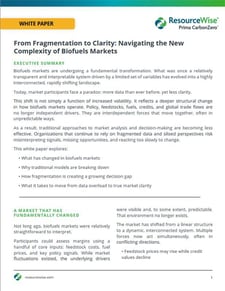 ResourceWise's white paper, From Fragmentation to Clarity: Navigating the New Complexity of Biofuels Markets, explores why these traditional approaches are breaking down, how fragmented insights are widening the decision gap, and how leading organizations are turning connected intelligence into a competitive advantage.

 ResourceWise: Oct 12, 2026, 2:25:00 PM
 ResourceWise: Oct 9, 2026, 9:12:17 AM
 ResourceWise: Oct 7, 2026, 8:57:37 AM

ResourceWise : Aug 10, 2026, 9:57:57 AM
Low-carbon fuels are entering the second half of 2026 with firmer price support. But production capacity alone is no longer telling the full story.

ResourceWise : Apr 29, 2026, 9:52:02 AM
Surging feedstock prices have pulled US renewable diesel producer margins down from recent highs. Even so, plants remain far more profitable than...

ResourceWise : Apr 6, 2026, 3:54:34 PM
The Iran War continues to substantially impact global economics, particularly within the energy and bioenergy fields. This month's market update...