
 Marko Summanen
New IRS 45Z Guidance Tightens Link Between Feedstocks and Biofuel Economics
 ResourceWise: Oct 12, 2026, 2:25:00 PM

If you've seen the film Moneyball, then you know it's a true story of how the Oakland A's transformed baseball by using data and analytics to outcompete teams with far larger budgets.
And at the end of the day, Moneyball isn't really about baseball.
It's about how organizations unlock competitive advantage when they stop relying on assumptions and start making data-driven decisions. And today, the pulp and paper industry is at a similar turning point.
At its core, Moneyball is a story about operating under constraints.
The Oakland A's couldn't outspend competitors, so they had to outperform them intellectually. They replaced tradition and “gut feel” with measurable performance drivers – focusing on what actually delivered results.
That shift is highly relevant to today's pulp, paper, and packaging supply chain.
With rising energy costs, tightening margins, and increasing pressure on asset performance, the mills and suppliers who win will be those that use benchmarking data to target the biggest improvement opportunities.
Traditional decision-making in industrial markets often depends on experience, relationships, and historical assumptions. But experience alone is not enough when markets are changing rapidly. With access to structured mill performance data, companies gain a new decision advantage – one grounded in evidence, not anecdotes.
Pulp and paper sales and strategy teams that rely only on prior wins are operating with a rear-view mirror.
The Oakland A’s weren’t trying to “buy players.” They were trying to buy runs, because runs win games.
In the pulp and paper ecosystem, suppliers shouldn’t be trying to “sell products.” They should focus on measurable outcomes such as:
That’s how value is created.
One of the biggest obstacles to performance improvement is simple:
“This is how we’ve always done it.”
In today’s environment, mills and suppliers need the courage to challenge accepted assumptions and use benchmarking evidence to identify what truly drives competitiveness.
Analytics often reveal uncomfortable truths, such as a mill underperforming its peers or having outdated energy systems.
The most successful leaders are the ones who accept the discomfort early, because it creates long-term advantage.
Moneyball was never rigid. The strategy stayed clear, but tactics evolved as new insights emerged.
The same applies to mill optimization. Data doesn’t replace judgment – it strengthens it.
Many suppliers still operate with a “door-knocking” model:
Call mill
That approach is expensive, inefficient, and increasingly ineffective. The future is targeted, evidence-based selling.
With industry intelligence platforms like FisherSolve®, suppliers can:
Identify true performance gaps versus best practices
That is Moneyball for the pulp and paper supply chain.
To illustrate the power of data-driven decision-making, consider a hypothetical benchmarking use case.
In the chart below, Mill X is benchmarked against its peer group—mills producing the same grade under comparable operating conditions. The analysis shows that Mill X is the largest producer in its segment, with higher output volumes than any of its competitors.
At the same time, Mill X also demonstrates the lowest asset-based risk in the group. When evaluated across key structural factors—including technical age, asset scale, maintenance capital requirements, and productivity—the mill stands out as a fundamentally strong and competitive operation.
This combination of large scale and low asset risk is a critical insight. It suggests that Mill X’s performance challenges are not driven by the core asset itself, but rather by specific cost and efficiency pressures—such as raw material exposure and, most notably, energy.
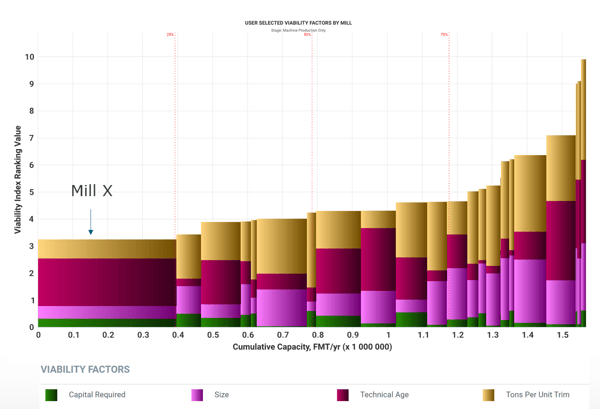
Image 1: FisherSolve Viability Benchmark
When we shift from viability benchmarking to cost benchmarking, another signal becomes clear: despite its strong structural position, Mill X operates in the fourth cost quartile, making it significantly less profitable than its size and competitiveness would suggest.
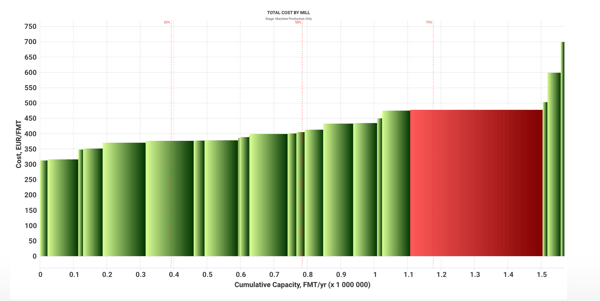 Image 2: FisherSolve Cost Benchmark
Among mills producing the same grade from similar fiber sources, energy cost per ton often becomes the dominant performance differentiator. In this benchmark, Mill X shows the highest purchased gas cost per ton, while also sourcing a substantial share of electricity from the grid.
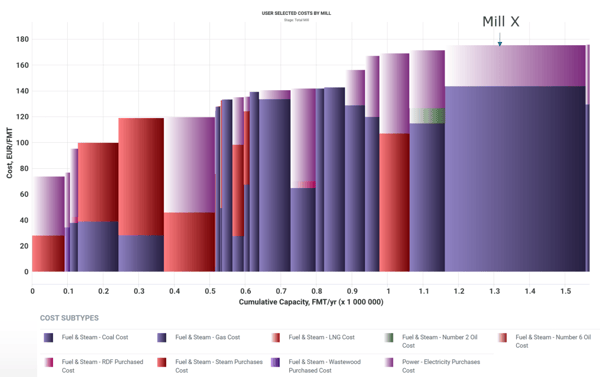 Image 3: FisherSolve Cost Benchmark
This raises an important operational question:
Is Mill X’s power and steam system optimized for today's market realities—or is it still an “energy island” built for an outdated product mix, legacy fuel conditions, and past power market constraints?
This is where benchmarking analytics creates actionable clarity. With data, mills and suppliers can pinpoint the true drivers of cost disadvantage and prioritize targeted optimization where it will deliver the highest return.
The bottom line is simple:
Without data:
Suppliers guess
Customers overspend
Resources are wasted
Win rates remain low
With data:
Suppliers target smarter
In today’s pulp and paper industry, competitive advantage no longer comes from instinct or tradition—it comes from insight. The mills and suppliers that win will be the ones who can identify performance gaps faster, benchmark more accurately, and act with confidence based on real evidence.
That’s exactly what FisherSolve delivers: the industry's most comprehensive dataset and analytical platform for mill benchmarking, cost optimization, asset strategy, and market intelligence. If you're ready to move beyond guesswork and start applying a true Moneyball playbook to your commercial and operational decisions, we invite you to explore how ResourceWise can help. Visit our Solutions page to learn more about FisherSolve and the tools that are redefining performance in the pulp and paper value chain.

 ResourceWise: Oct 12, 2026, 2:25:00 PM
 ResourceWise: Oct 9, 2026, 9:12:17 AM
 ResourceWise: Oct 7, 2026, 8:57:37 AM
 Matt Elhardt : Nov 7, 2023, 12:00:00 AM
Maintaining a competitive advantage in today’s dynamic pulp and paper industry is essential for success. However, optimizing business decisions in...

 Amy Chu : Feb 25, 2026, 1:34:09 PM
The global pulp and paper industry is entering a new phase of structural transformation. While overall growth remains steady, regional divergence is...

ResourceWise : Apr 10, 2026, 10:40:40 AM
Volatility is no longer a one-time disruption—it’s the baseline for today’s pulp and paper industry.