US Diesel Export Ban Update: G7 Stock Release Eases Risk
 ResourceWise: Oct 5, 2026, 11:42:56 AM
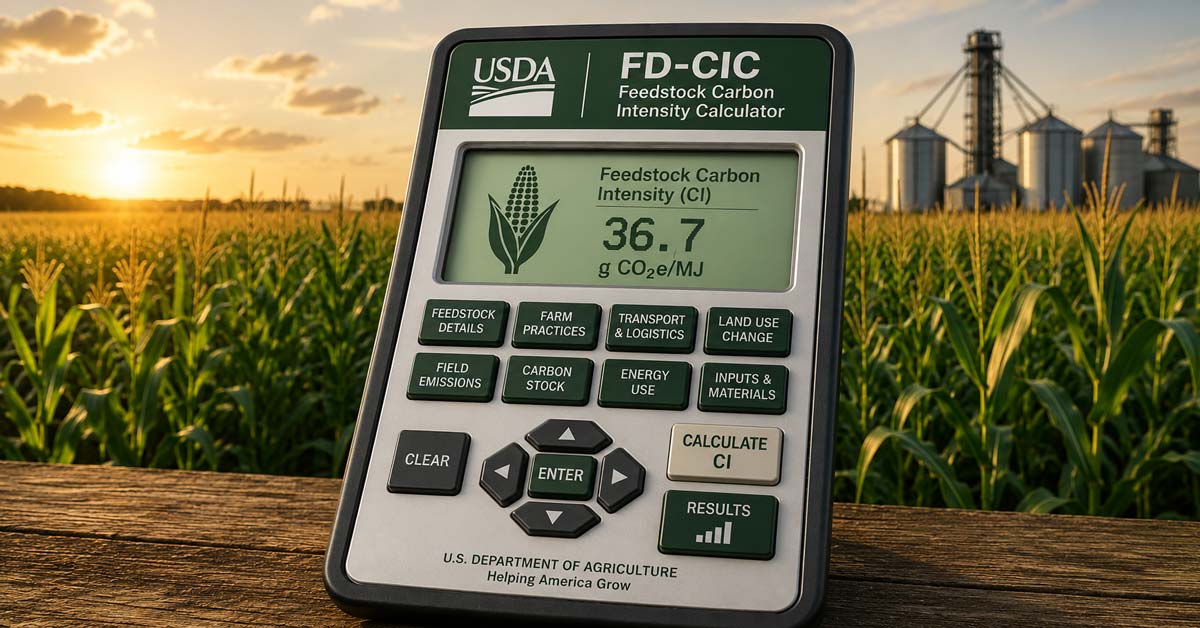
The USDA has released its long-awaited Feedstock Carbon Intensity Calculator, officially known as the USDA FD-CIC. For growers, biofuel producers, and low-carbon fuel market participants, the calculator is a meaningful step toward assigning a standardized number to the extent that certain farm-level practices affect the carbon intensity of major biofuel feedstocks.
The final rule governing the tool establishes guidelines for quantifying, reporting, and verifying the carbon intensity of regenerative biofuel feedstock commodity crops grown in the United States.
At its core, the USDA Feedstock Carbon Intensity Calculator estimates the carbon intensity, or CI, of select crops used as biofuel feedstocks. The USDA defines CI for biofuel feedstock crops as the estimated greenhouse gas emissions per unit of production, expressed as grams of carbon dioxide equivalent per bushel.
The current version applies to four domestic feedstock crops:
Field Corn
Soybeans
Sorghum
Spring Canola
For those crops, the calculator reflects the impact of specified regenerative or low-carbon agricultural practices used during crop production. The USDA says the tool allows producers to evaluate several factors:
Nutrient Management
No-till
Reduced Till
Cover Crops
Nitrification Inhibitors
Manure Nitrogen
The real change comes in the specificity. Growers now have a published USDA methodology and calculator for reflecting certain field-level management choices in an officially recognized CI calculation.
The FD-CIC is designed to calculate a field-level, crop-specific CI. In practical terms, that means a grower does not simply enter whole-farm averages and receive one blanket number. Instead, the calculator is meant to account for specific fields or management units, crop types, nutrient management, and qualifying low-carbon practices.
According to the final rule, producers must calculate a field-level CI for each field or management unit using nutrient management or a unique combination of nutrient management and low-carbon practices. The result represents the net greenhouse gas emissions from producing one bushel of that crop on that field or management unit.
Required inputs include:
Farm Location
Crop Type
Acres
Actual and Expected Yield
Total Synthetic Nitrogen Applied per Acre
Use of No-till or Reduced Till
Use of a Cover Crop or Grazed Cover Crop
For growers, the calculator gives farm practices a more formal role in feedstock CI accounting. Practices that were previously difficult to translate into recognized CI values now have a clearer pathway into carbon-intensity calculations for eligible crops.
The calculator matters because feedstock emissions are a meaningful part of the carbon footprint for crop-based biofuels.
The USDA notes that feedstock crop production emissions account for more than 50% of direct emissions from producing corn ethanol and approximately half of direct emissions from producing soybean biodiesel. This excludes land-use change and other market-mediated effects.
The numbers show a potential market signal. If a grower can produce a lower-CI feedstock, and if a downstream program recognizes that CI value, there may be an opportunity for the value of those practices to flow back through the supply chain.
This is especially relevant for biofuel policy. The 45Z Clean Fuel Production Credit applies to clean transportation fuel produced domestically after December 31, 2024, and sold by December 31, 2029. The US Treasury and the IRS have also said they anticipate that a 45Z-specific version of the FD-CIC module will be included as an input to the DOE’s 45ZCF-GREET model for calculating CI adjustments under section 45Z.
That connection is not automatic, however. The Treasury and the IRS also anticipate additional requirements around agricultural practice implementation, recordkeeping, and verification. Additional guidance is expected alongside the publication of the 45Z-specific FD-CIC module.
The calculator is an important milestone, but it is not a universal crop-carbon tool. It currently applies only to field corn, soybeans, sorghum, and spring canola. It also covers specific low-carbon practices, including no-till, reduced till, cover crops, and nutrient management.
One point worth clarifying: cover crops are included as a practice in the calculator, but broader feedstock eligibility remains limited.
The USDA received comments requesting more than thirty additional feedstocks, including crop residues, cellulosic crops, pennycress, and prairie biomass. The USDA also received requests to include intermediate oilseeds such as winter canola, carinata, pennycress, and camelina. However, the organization said more data and research are needed before adding intermediate crops.
The final rule also leaves room for future development. The USDA acknowledged comments supporting conservation crop rotation as a qualifying practice and said it may consider adding the practice in the future. Additional research and data are needed to quantify its potential CI benefits.
A useful way to understand the FD-CIC is to think about two corn fields on the same farm. Both fields produce field corn, and both may have similar acreage, location, and yield expectations. But they are managed differently.
Field A uses conventional tillage, does not use a cover crop, and relies entirely on synthetic nitrogen fertilizer without a nitrification inhibitor.
Field B uses no-till, plants a cover crop, applies part of its nitrogen through manure, and treats a portion of its synthetic nitrogen with a nitrification inhibitor.
Under the USDA FD-CIC, those differences matter. The calculator is designed to quantify carbon intensity in grams of carbon dioxide equivalent per bushel for eligible crops, including field corn.
The USDA says the tool reflects specified regenerative practices used during crop production:
No-till
Reduced Till
Cover Crops
Nitrification Inhibitors
Manure Nitrogen
The result is not one generic CI score for the whole farm. Instead, each field's management choices can feed into a field-level, crop-specific CI calculation.
In this example, Field B would be expected to show a lower CI than Field A because it uses practices that the calculator recognizes as reducing emissions or improving the feedstock production emissions profile.
The exact CI values would still need to be generated by the USDA tool. But the comparison shows why the calculator matters. It gives growers a way to translate specific agronomic decisions into a number that may be relevant for biofuel producers, tax credit calculations, and other low-carbon fuel markets.
The FD-CIC gives growers and biofuel supply chains a more standardized way to account for certain on-farm practices. That is a meaningful step for agricultural participation in low-carbon fuel markets.
But the tool should not be confused with a full lifecycle assessment or a carbon offset protocol. The USDA states that the FD-CIC does not include land-use change or other market-mediated effects. Additionally, values calculated by the tool may not represent values generated by, or applicable to, other program-specific methodologies.
For now, the calculator is best understood as a foundation. It provides eligible growers with a USDA-backed method for estimating field-level feedstock CI, biofuel producers with a clearer way to evaluate certain upstream agricultural practices, and policymakers with a framework that can evolve as more feedstocks, practices, and data become available.
The next question for the market is not whether agriculture can be part of low-carbon fuel accounting, as the USDA has now provided a more concrete methodology for that. Instead, it's how quickly fuel programs, tax credit guidance, and private markets will incorporate the calculator—and how much of that value will ultimately reach the farm gate.

 ResourceWise: Oct 5, 2026, 11:42:56 AM
 Jennifer Hawkins: Oct 2, 2026, 9:29:05 AM

ResourceWise : Jul 2, 2026, 8:11:52 AM
For months, one of the biggest open questions in the US biofuels market has been how farm-level carbon reductions would translate into 45Z credit...
ResourceWise : Mar 13, 2025, 12:00:00 AM
As sourcing for feedstocks in renewable energy and biofuel production ramps up, the scope of feedstock materials has expanded. Waste biomass...
 Jane Denny : Jul 31, 2024, 12:00:00 AM
Biobased products are defined as having been made from biological—meaning living—or renewable resources. They include corn, sugar cane, cellulosic,...