
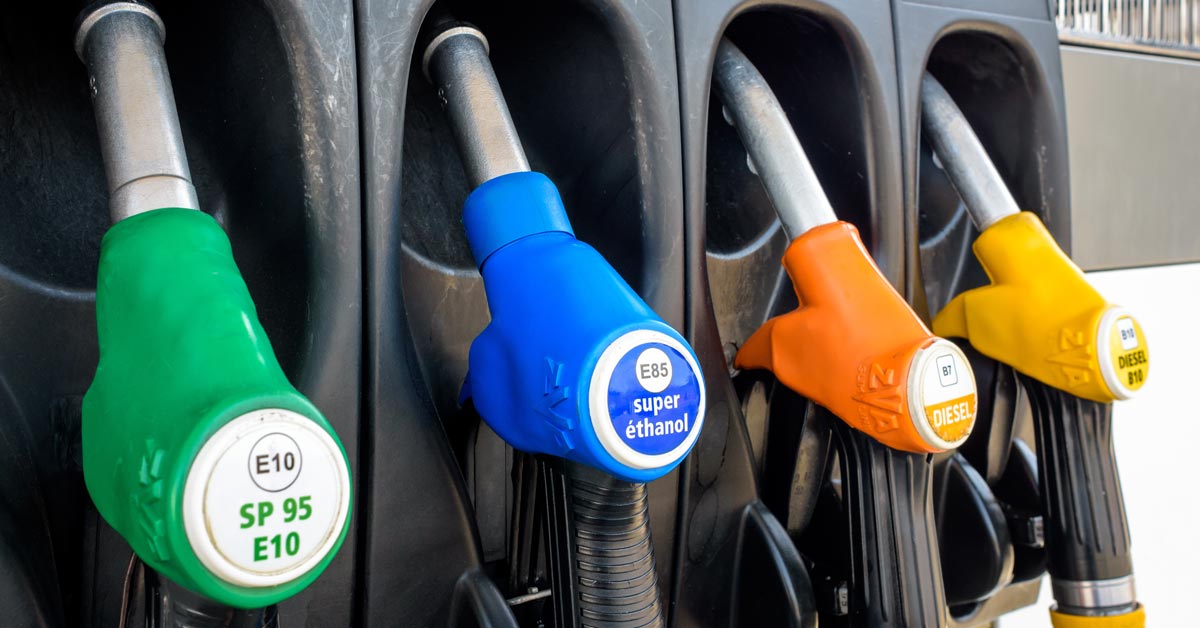
What Is Biofuel Blending and How Does It Work?
 ResourceWise: Sep 14, 2026, 2:40:15 PM

The European Commission's latest review of the EU Emissions Trading System could mark a significant turning point for Europe's emerging carbon-removal industry. The implications also extend to the biofuels, biomass, pulp and paper, and biorefining sectors that produce concentrated streams of biogenic carbon dioxide.
The proposal would integrate certain domestic permanent carbon removals into the EU ETS from 2031. In practice, it could create a large, officially backed source of future demand for removals generated through bioenergy with carbon capture and storage, or BioCCS, and direct air carbon capture and storage, or DACCS.
The proposal remains subject to the EU legislative process, and many commercial details have yet to be defined. Nevertheless, its direction is important.
By establishing a mechanism for the European Commission to purchase permanent carbon-removal units, the EU is signaling that verified removals could become a recognized carbon asset class alongside traditional EU allowances.
For biogenic emitters, that distinction could materially strengthen the investment case for carbon-capture projects.
Facilities such as biomass-fired power plants, pulp and paper mills, ethanol plants, and other biorefineries often release carbon dioxide originating from recently grown biomass rather than fossil feedstocks.
Capturing and permanently storing this biogenic CO₂ can create a net removal from the atmosphere. Until now, however, the economics of these projects have depended heavily on three factors:
Voluntary carbon markets
Bilateral offtake agreements
Governmental support
The proposed EU ETS reforms could add a new source of long-term demand.
Under the Commission's plan, 250 million additional EU allowances would be auctioned between 2031 and 2040. The revenue would be used by the Commission to purchase an equivalent volume of eligible domestic permanent carbon-removal units certified under the EU Carbon Removals and Carbon Farming Regulation.
A further ten million allowances could be auctioned if the initial funding proves insufficient to purchase the targeted volume of removals.
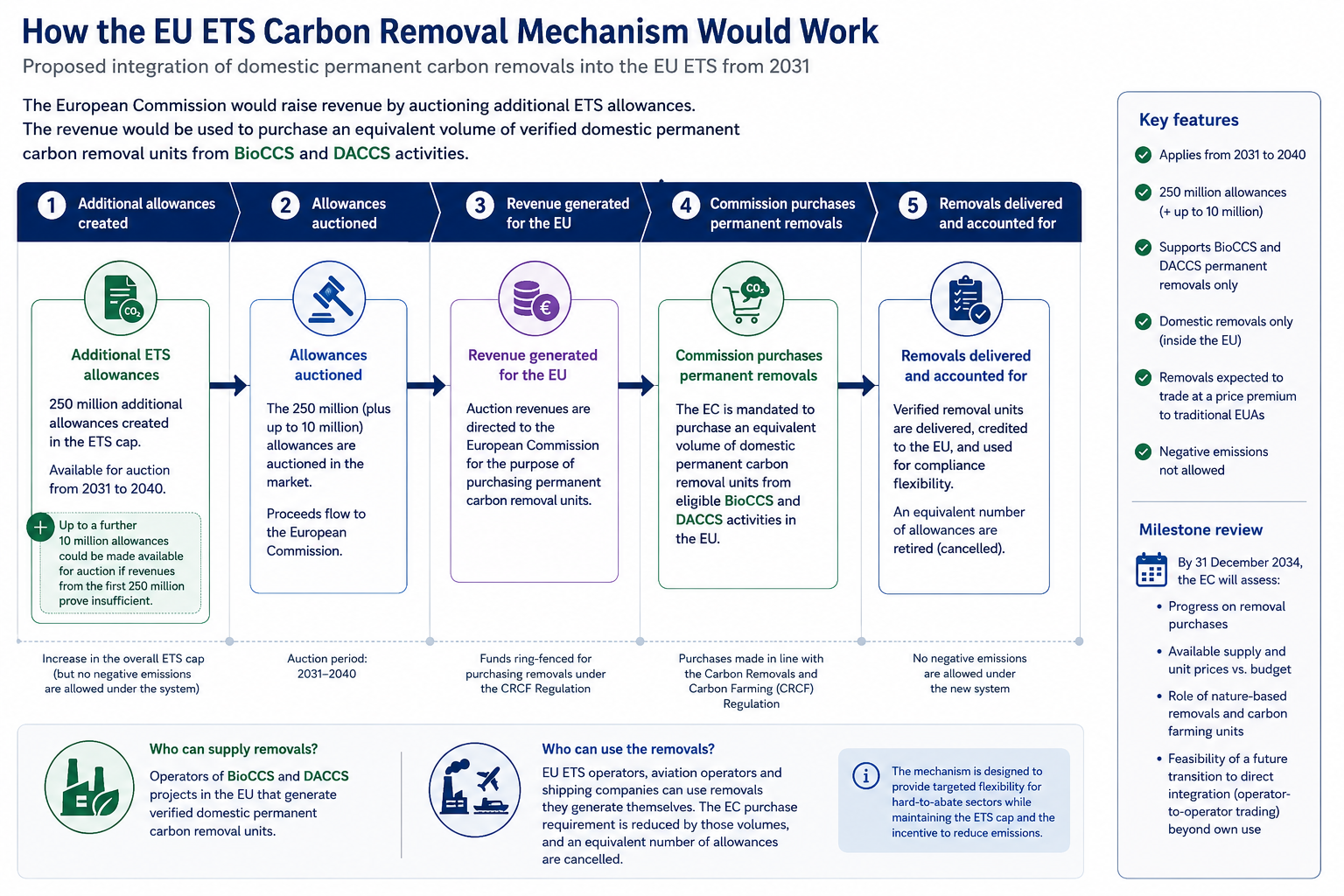
The model effectively places the Commission in a central market-making role. Rather than requiring removal developers to depend exclusively on voluntary buyers, the mechanism could provide a regulated source of demand backed by one of the world's largest carbon markets.
For project developers and investors, this could improve visibility over future revenues and support the bankability of capture, transport, and storage infrastructure.
The proposal does not specify the price the Commission would pay for carbon removals. However, it does recognize that permanent removal units are likely to cost more than conventional EU allowances.
That premium matters.
An EU allowance represents permission to emit one metric ton of carbon dioxide equivalent under the declining ETS cap. A permanent removal unit, by contrast, represents carbon dioxide taken from the atmosphere and stored for the long term.
Treating removals as a separate, higher-value asset reflects the different function they perform within the carbon market.
It also suggests that the EU does not intend to flood the ETS with low-cost removals that could weaken the incentive for industrial decarbonization. Instead, removals would provide targeted flexibility for emissions that are technically difficult or disproportionately expensive to eliminate.
The Commission explicitly argues that some residual emissions in hard-to-abate sectors may be more cost-effectively balanced through permanent removals than through direct abatement. It also warns that excluding this flexibility could harm European competitiveness while slowing the deployment of negative-emissions technologies.
The proposal could be particularly beneficial for biogenic carbon-capture projects because many already have access to relatively pure and concentrated CO₂ streams.
Fermentation-based biofuel production is a notable example. During ethanol production, fermentation releases a high-purity stream of biogenic CO₂ that can be less complex and less expensive to capture than emissions from combustion or industrial flue gases.
Pulp and paper mills, biomass power plants, renewable natural gas facilities, and emerging biorefineries may also offer opportunities. But capture costs and technical requirements vary substantially by facility.
This cost advantage has made biogenic carbon capture one of the more commercially promising routes to engineered carbon removal. The EU proposal reinforces that position by linking eligible removals to a future compliance-market revenue stream.
Not every carbon-capture project would qualify. The proposal focuses on domestic permanent removals from BioCCS and DACCS activities. Carbon captured from fossil or mixed waste streams, for example, would not automatically qualify as biogenic removal.
This distinction highlights a broader shift in carbon-market policy. The origin of the carbon, the method of capture, and the durability of storage are becoming as important as the volume captured.
The proposed 250 million removal units would be introduced over 10 years, averaging 25 million metric tons annually.
Compared with the more than one billion metric tons of verified emissions currently covered by the EU ETS, this represents roughly 2.5% of present emissions. While that number may not initially appear very large, it understates the mechanism's potential future significance.
EU ETS emissions are expected to continue declining as the cap tightens and industrial decarbonization progresses. If covered emissions fall substantially by 2040, removals could account for a much larger share of the remaining market, about 5% under some emissions-reduction scenarios.
The role of removals is therefore likely to grow as the ETS approaches its long-term objective.
The easier and lower-cost emissions reductions will generally occur first. Over time, the system will increasingly confront residual emissions from aviation, shipping, chemicals, cement, steel, and other sectors where complete abatement remains technically or economically challenging.
That is where permanent carbon removals could become most valuable.
The implications of this reform extend beyond dedicated carbon-removal developers as well.
For the biofuels industry, carbon capture could become an increasingly important source of margin diversification. Producers have historically been exposed to volatile feedstock costs, fuel prices, policy incentives, and compliance-credit markets. Monetizing biogenic CO₂ removal could add another revenue stream while further reducing the carbon intensity of their products.
This could be particularly important, as low-carbon fuel markets place greater emphasis on full-lifecycle emissions.
For instance, a biofuel producer that captures and permanently stores fermentation CO₂ may be able to achieve a substantially lower, or even negative, carbon-intensity profile. Of course, this depends on several elements:
Feedstock
Production process
Energy source
Accounting methodology
Applicable regulations
That creates several possible sources of value:
Revenue from the sale of certified carbon-removal units
Improved carbon-intensity scores in low-carbon fuel programs
Greater differentiation in voluntary and regulated fuel markets
Stronger alignment with aviation and maritime customers seeking lower-emissions fuels
Potential participation in shared CO₂ transport and storage infrastructure
The result could be a closer convergence between the biofuels and carbon-management markets.
Future biorefineries may increasingly be evaluated not only by how much renewable fuel they produce, but also by how efficiently they manage, capture, and permanently store their biogenic carbon.
Policy support alone will not guarantee project development.
European biogenic emitters will still require access to capture equipment, aggregation networks, pipelines, shipping terminals, injection sites, and verified geological storage. Projects must also meet the EU's requirements for permanence, monitoring, certification, and lifecycle accounting.
Location will therefore be critical.
Facilities near planned CO₂ hubs and storage corridors may be able to develop capture projects sooner and at lower cost. More isolated plants could face higher transportation costs or struggle to achieve sufficient scale without regional partnerships.
This dynamic could encourage industrial clustering. Biofuel plants, pulp mills, biomass facilities, waste processors, and other emitters may seek to share transport and storage infrastructure, reducing unit costs and improving project economics.
It may also influence future investment decisions. Access to CO₂ infrastructure could become an increasingly important factor in companies' decisions about where to expand, retrofit, or build new biorefineries.
The inclusion of removals in the EU ETS has long been controversial.
Critics argue that an abundant supply of removal credits could allow companies to delay physical emissions reductions. If removals become a broad substitute for industrial decarbonization, the mechanism could weaken the carbon price signal and prolong the use of high-emission assets.
The Commission's proposed structure appears to limit that risk.
The central purchasing model would control the number of removal units entering the system. Meanwhile, the additional allowances for purchases would be defined in advance. The proposal would also prohibit the creation of negative emissions within the ETS itself.
In addition, the quantity purchased by the Commission would be reduced when ETS operators use their own BioCCS removals. A corresponding number of allowances would then be canceled from the additional pool.
The intention is to treat removals as a complement to emissions reductions and not as an unlimited alternative.
Whether the final system achieves that balance will depend on volume limits, eligibility rules, pricing, and how removal units can ultimately be used by regulated companies.
The proposal includes an important review point on December 31, 2034.
By that date, the Commission will assess the available supply and cost of domestic permanent removals, compare purchasing requirements with the allocated budget, and examine whether nature-based removals and carbon-farming units could play a role.
It would also consider moving from a centrally managed model toward more direct trading between removal suppliers and ETS operators.
That progression could be significant. The Commission-led purchasing mechanism may serve as a bridge in several ways:
To support early projects
To establish certification standards
To generate price discovery
To help the market build sufficient scale before direct commercial trading expands
For developers, the period between now and 2034 will therefore be crucial. Projects that secure storage access, complete certification pathways, and establish robust carbon accounting may be best positioned to supply the emerging market.
The EU's proposal reflects a broader change in climate policy.
For much of the past two decades, carbon markets have focused primarily on reducing emissions. As Europe moves closer to its 2040 and 2050 climate targets, policymakers are increasingly confronting a second challenge: how to neutralize emissions that cannot be fully eliminated and how to achieve net-negative emissions thereafter.
Permanent carbon removal is moving from the margins of voluntary climate action toward the center of regulated industrial policy.
For the biofuels sector, this shift presents both an opportunity and a strategic question. Biogenic CO₂ can no longer be viewed solely as a byproduct of renewable-fuel production. In the right regulatory and infrastructure environment, it can become a valuable input into a wider carbon-management system.
The Commission’s proposal does not yet provide all the answers. Pricing, project eligibility, accounting rules, and access to transport and storage remain uncertain. Its significance lies in the signal it sends.
Europe is beginning to build permanent carbon removal into the architecture of its flagship carbon market. For biogenic emitters, this could transform carbon capture from a largely policy-dependent environmental project into a core component of long-term business strategy.


 Sam Uctas: Sep 14, 2026, 1:23:22 PM

 Javier Rivera: Sep 14, 2026, 10:20:43 AM
ResourceWise : Dec 2, 2025, 10:01:53 AM
A new study commissioned by Transport & Environment (T&E), a leading European clean-transport NGO (non-government organization), is shining a...

ResourceWise : Jul 8, 2026, 9:22:27 AM
The USDA has released its long-awaited Feedstock Carbon Intensity Calculator, officially known as the USDA FD-CIC. For growers, biofuel producers,...
ResourceWise : Mar 13, 2025, 12:00:00 AM
As sourcing for feedstocks in renewable energy and biofuel production ramps up, the scope of feedstock materials has expanded. Waste biomass...