 Suz-Anne Kinney

The MarketWatch Blog is Transitioning to ResourceWise Forest Products
 Forest2Market: July 14, 2023
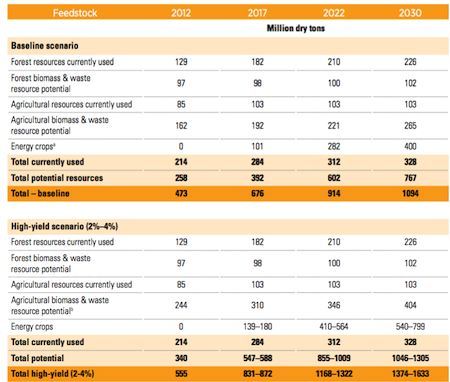
The Department of Energy recently published an update to its 2005 Billion Ton Study. In U.S. Billion-Ton Update: Biomass Supply for a Bioenergy and Bioproducts Industry, the DOE reaches similar conclusions to those it reached in the 2005 version of the study. If you consider forest biomass, agricultural biomass, and energy crops, more than 1 billion tons will be available for the production of energy.
While we will cover this study in more detail when we've had time to digest it (it's 180 pages), the following table from the study indicates the number of dry tons of biomass that will be available by source and year, according to the DOE.
Table. Summary of Currently Used and Potential Forest and Agriculture Biomass at $60 per Dry Ton or Less, under Baseline and High-Yield Scenario Assumptions
DOE Estimates Biomass Availability through 2030
Note: Under the high-yield scenario, energy crops are shown for 2% to 4% annual increase in yield. Numbers may not add up due to rounding. For forest products, prices are at roadside, not delivered. a Energy crops are planted starting in 2014. b Agricultural residues are generated under a high-yield traditional crop scenario with high no-till adoption (see Table 4.6). Energy crop yield growth follows a baseline growth pattern of 1% annually.
This table can be found on page xxv of the study.
 Suz-Anne Kinney : April 6, 2009
A February report in the Charleston Regional Business Journal describes efforts by Agri-Tech Producers CEO Joe James to develop four torrefaction...
Suz-Anne Kinney : September 16, 2010
Despite climate change, the need for energy security and the Gulf oil disaster, residents living near proposed biomass facilities have made it...
Suz-Anne Kinney : March 12, 2009
One particularly helpful provision of the American Recovery and Reinvestment Act of 2009 is the extension of and alternatives to the production tax...