
 Bruce Janda
New IRS 45Z Guidance Tightens Link Between Feedstocks and Biofuel Economics
 ResourceWise: Oct 12, 2026, 2:25:00 PM
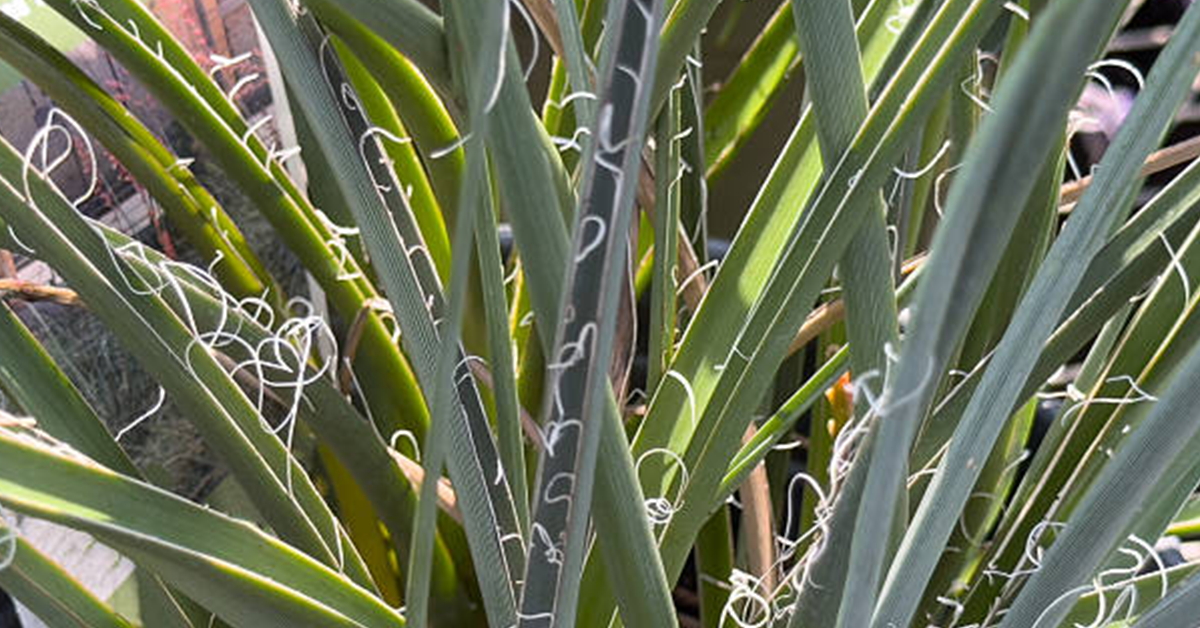
Hesperaloe is a desert plant with unusually long, slender fibers that could provide an alternative to northern bleached softwood kraft pulp (NBSK) in premium tissue products. Kimberly-Clark is investing in Hesperaloe because the fiber may offer the combination of strength and softness tissue producers need while reducing dependence on a constrained Canadian softwood pulp supply.
The opportunity is significant, but so is the risk. Developing Hesperaloe into a commercially viable fiber source will require breakthroughs in agriculture, processing, and supply-chain development. Kimberly-Clark’s recently announced $100 million pilot plant in Yuma, Arizona, suggests the company believes the potential is worth exploring.
Kimberly-Clark and several of its US tissue competitors are facing increased scrutiny over their reliance on Canadian-produced northern bleached softwood kraft pulp. Environmental groups, including the Natural Resources Defense Council (NRDC), argue that Canadian NBSK production contributes to the loss of old-growth forests.
At the same time, global supply has remained largely static for nearly two decades.
The chart below shows pulp production by region. For Kimberly-Clark and its US-based competitors, the key issue is that North American production, which is largely Canadian, has declined while producers in Northern Europe have only slowly added capacity.
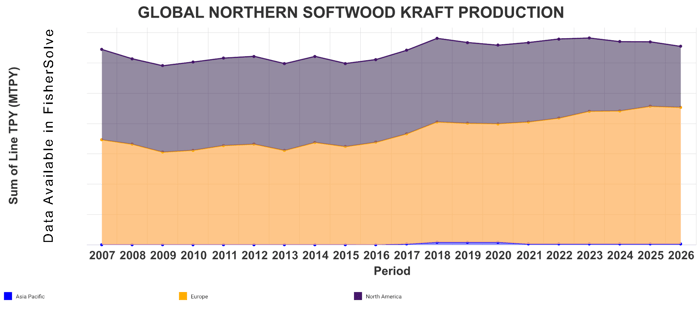
The result is both an environmental and a supply-chain challenge for tissue producers that depend on northern softwood fiber.
Softwood pulp provides the strength tissue producers need to create soft, high-performing products.
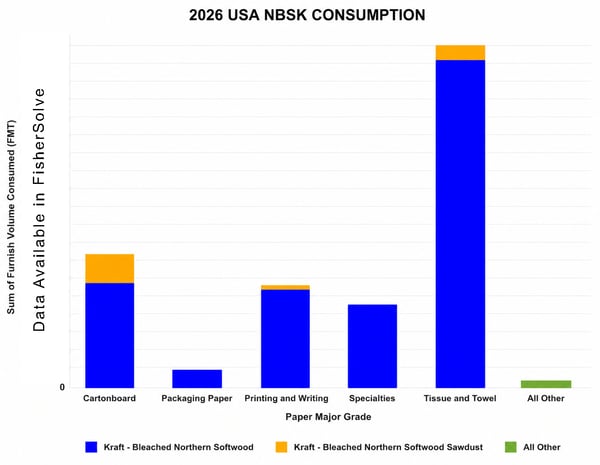
The next chart shows where this fiber is used in the United States. Tissue and towel grades dominate northern bleached softwood kraft pulp consumption because the fiber is highly valued for producing the softness and strength expected in ultra-premium, high-margin bath tissue, facial tissue, and paper towel products.
Kimberly-Clark has pledged to find alternatives and has worked with the NRDC for roughly two decades. But the challenge is bigger than environmental pressure alone.
The company needs an alternative fiber that can protect product performance, reduce supply risk, and support its premium-brand strategy.
That combination is difficult to find.
Most alternative fibers cannot provide the same combination of fiber length, strength, and softness as northern softwood pulp.
Recent interest in alternative tissue fibers has centered on bamboo, wheat straw, and other non-wood sources. Some fibers, such as bagasse from sugar cane, have been used in tissue production for generations.
Yet, non-wood fibers have not meaningfully displaced wood pulps unless they deliver a clear cost advantage, often because the fiber is a byproduct of food production.
Most non-wood fibers are short and can replace hardwood or recycled pulps, but they do not provide the strength needed to maximize softness in ultra-premium tissue. Longer fibers are required to add strength without sacrificing softness.
Northern softwood pulps provide that balance better than coarser southern softwood pulps. Some bamboo species can provide medium-length fiber, but they do not match the low coarseness and softness associated with northern softwood kraft pulp.
That is what makes Hesperaloe particularly interesting.
Hesperaloe is a desert plant native to Arizona, California, and Sonora, Mexico. Its long, slender fibers may allow it to provide strength similar to northern softwood pulp while maintaining very low fiber coarseness.
The plant also grows with very little water, particularly compared with cotton, one of the thirstiest commercial crops. Its low lignin content may make pulping easier and less capital-intensive.
As a result, Hesperaloe is a candidate for simpler chemical-mechanical processes that are also being explored for other non-wood fibers.
The idea itself is not new. Hesperaloe first appeared in the patent literature in a 1993 James River (Georgia-Pacific) patent, followed by a 1999 pulping process developed by Hurter Consulting and North Carolina State University.
What has changed is the scale of the effort to determine whether the fiber can become commercially viable.
Kimberly-Clark’s patent activity suggests that the company has been pursuing the broader fiber challenge systematically for years.
It has been granted at least six US patents covering tissue with high bulk, high dispersibility, high strength and low stiffness, high towel durability, and high-yield fibers. A 2026 patent filing indicates that the work remains active.
The patent trail provides important context for Kimberly-Clark’s next step: moving the concept closer to commercial-scale production.
Kimberly-Clark’s recently announced $100 million pilot plant in Yuma, Arizona, is designed to explore whether Hesperaloe can become a viable new source of long, low-coarseness fiber for premium tissue.
The project is not simply another attempt to use non-wood pulp.
Instead, it is an effort to develop a fiber that could replace northern bleached softwood kraft pulp and potentially raise the softness-and-strength ceiling for premium tissue.
If successful, Hesperaloe fiber could support Kimberly-Clark’s Powering Care strategy by enabling differentiated, science-based products while reducing dependence on a constrained supply chain facing environmental criticism.
The NRDC says Kimberly-Clark has spent more than $250 million on related research and development over the past two decades to reach the pilot-plant stage.
The key advantage of Hesperaloe is its unusual fiber morphology.
Hesperaloe produces long, slender fibers that could potentially deliver greater softness and strength than today’s typical blend of northern softwood kraft pulp and eucalyptus.
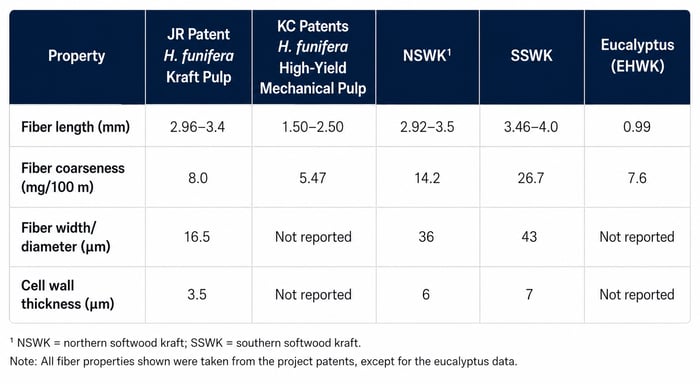
The table below highlights the fiber properties that make Hesperaloe relevant to ultra-premium tissue production.
The original James River patent used a more conventional kraft pulping process, which would bring higher capital costs and greater environmental concerns. Kimberly-Clark’s patents instead describe a high-yield chemical-mechanical pulp that could require much lower capital investment and leave a smaller environmental footprint.
All fiber properties shown in the table were taken from the project patents, except for the eucalyptus data.
Fiber coarseness may be the most important characteristic separating Hesperaloe from conventional long-fiber alternatives.
Hesperaloe fiber lengths extend beyond bamboo and approach the range of northern softwood kraft pulp. At the same time, its coarseness appears similar to, or even lower than, eucalyptus.
That is an unusual combination.
Long fibers can provide strength, while lower coarseness can help support softness. If Hesperaloe can consistently deliver both characteristics at commercial scale, Kimberly-Clark could produce tissue that is softer and stronger than current ultra-premium formulas.
That performance might also create room to blend in some lower-cost or recycled fiber without sacrificing the characteristics consumers expect from premium products.
Potentially – but commercial-scale replacement is far from certain.
The concept remains a high-risk, long-horizon supply-chain bet. Building a commercial Hesperaloe crop in the desert will require agronomic, processing, and supply-chain breakthroughs.
Kimberly-Clark must demonstrate not only that Hesperaloe performs well in tissue, but also that the plant can be grown, harvested, processed, transported, and pulped economically at the volumes required by a major tissue producer.
The Yuma pilot plant should help determine whether those pieces can come together.
If the Yuma pilot succeeds, Kimberly-Clark could gain greater control over a critical premium-tissue input while creating new opportunities for product differentiation.
A commercial Hesperaloe fiber supply could potentially provide three strategic advantages: reduced exposure to constrained northern softwood pulp supplies, an alternative fiber with favorable environmental characteristics, and patent-protected performance advantages in premium tissue products.
Those benefits are not guaranteed. Creating an entirely new desert-grown fiber supply remains a substantial execution risk.
But if Kimberly-Clark can overcome those challenges, Hesperaloe could give the company a rare combination of environmental differentiation, differentiated product performance, and greater control over one of the most important fiber inputs used in premium tissue.
The pulp and paper industry is constantly evolving. Stay ahead of the latest market developments, emerging trends, and industry news by subscribing to the ResourceWise newsletter for expert insights delivered straight to your inbox.

What is Hesperaloe?
Hesperaloe is a desert plant native to Arizona, California, and Sonora, Mexico. It produces long, slender fibers that may make it suitable as an alternative source of fiber for premium tissue products.
Why is Kimberly-Clark interested in Hesperaloe?
Kimberly-Clark is exploring Hesperaloe because its fiber could potentially provide the strength and softness associated with northern softwood pulp while reducing dependence on a constrained and environmentally scrutinized supply source.
Can Hesperaloe replace NBSK in tissue?
Potentially, but that has not yet been demonstrated at a commercial scale. Kimberly-Clark must prove that Hesperaloe can be grown and processed economically while delivering consistent fiber and tissue performance.
Why is fiber length important in tissue production?
Long fibers provide strength. In ultra-premium tissue, producers need enough strength to maintain product performance without using coarser fibers that can reduce softness.
What makes Hesperaloe different from bamboo?
Some bamboo species provide medium-length fibers, but Hesperaloe's fibers can approach the length of northern softwood kraft pulp while maintaining unusually low coarseness. That combination could make it particularly useful for soft, strong premium tissue.
 ResourceWise: Oct 12, 2026, 2:25:00 PM
 ResourceWise: Oct 9, 2026, 9:12:17 AM
 ResourceWise: Oct 7, 2026, 8:57:37 AM
 Bruce Janda : Aug 26, 2024, 12:00:00 AM
Since the Industrial Revolution, the United Kingdom has been a hub of global trade and innovation. This legacy has been carried over into the modern...
Bruce Janda : Feb 14, 2024, 12:00:00 AM
In today's ever-evolving world, businesses must stay up to date with the latest industry trends and regulations. One area that has garnered...
1 min read
Bruce Janda : Apr 13, 2023, 12:00:00 AM
When we last focused on Germany's tissue market more than two years ago, the world was dealing with the severe disruptions of the Covid-19 pandemic....