
New IRS 45Z Guidance Tightens Link Between Feedstocks and Biofuel Economics
 ResourceWise: Oct 12, 2026, 2:25:00 PM
Singapore's bio-bunker market showed signs of recovery in July 2026. But the significant sales downturn remains difficult to ignore.
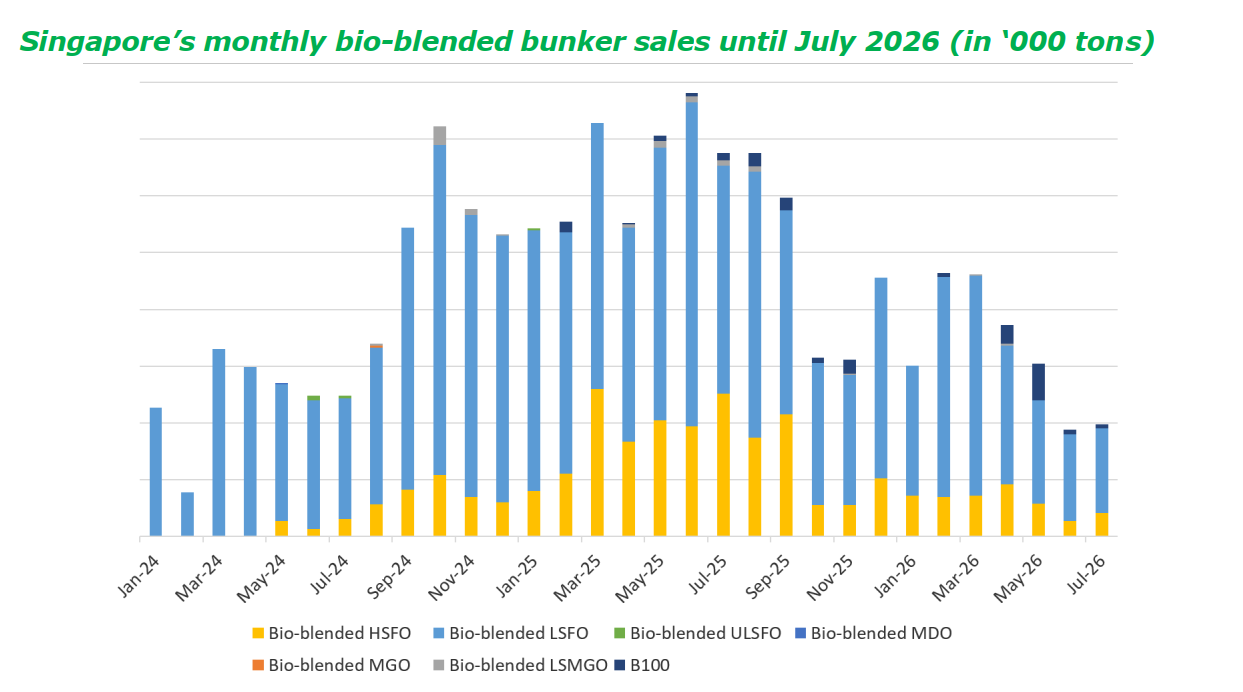
Bio-bunker sales increased 5.3% month over month between June and July, yet volumes remained roughly 70% below July 2025 levels. Bio-blended fuels and B100 accounted for just 0.83% of Singapore's bunker sales, compared with 2.75% a year earlier.
So, why are Singapore's bio-bunker sales struggling despite the maritime industry's broader push toward lower-carbon fuels?
The latest data suggests that the market has yet to establish sustained demand momentum:
Conventional bunker volumes remain dominant
B100 sales have retreated sharply from earlier in the year
Singapore's biofuel market share remains well below 2025 levels
At the same time, developments elsewhere, particularly in Europe, illustrate how regulation and compliance incentives can materially change the economics of lower-carbon marine fuels.
Yes, but only modestly. July's improvement represents a recovery from June rather than a return to the much stronger volumes recorded in 2025.
According to Maritime and Port Authority of Singapore (MPA) data included in ResourceWise's latest Bio-Bunkering at a Glance report, total bio-bunker sales increased by 5.3% from June to July.
Viewed in isolation, July data looks encouraging. Zoom out, however, and the recovery appears much less substantial.
The chart below illustrates just how dramatically monthly bio-bunker demand has retreated from its previous highs.
(Source: ResourceWise Bio-Bunkering at a Glance Report)
Bio-blended fuels and B100 represented only 0.83% of Singapore's total bunker sales in July 2026.
That was effectively unchanged from June's 0.8% market share, but substantially below the 2.75% recorded in July 2025. This distinction matters.
Singapore remains one of the world's most important bunkering hubs. Accordingly, overall fuel demand remains substantial.
Conventional bunker sales excluding LNG actually increased slightly between June and July. LNG sales also increased.
The weakness isn't simply the result of fewer ships buying fuel. Instead, biofuels are capturing a considerably smaller share of the bunker pool than they were a year ago.
The contrast with Europe provides important context.
ResourceWise data shows that Rotterdam bio-bunker prices continued to rise during August. B30 HSFO and B30 LSMGO assessments increased modestly month over month, while B30 VLSFO showed a substantially larger increase. Singapore's B24 assessments, meanwhile, were mixed.
But price alone doesn't explain the difference.
Europe is increasingly developing policy mechanisms that directly influence the economics of renewable marine fuels. In the Netherlands, for example, maritime certificate prices increased 17% month over month in August, significantly increasing the rebate associated with Dutch bio-bunkering.
Additionally, European markets are introducing shipping-specific renewable fuel requirements.
According to ResourceWise analysts, Spain will introduce a GHG-reduction-based mandate for inland shipping beginning in 2027. Its initial obligation of 6.5% will eventually increase to 33% by 2040. The Netherlands already has its own inland and international maritime requirements.
These policies do not guarantee stronger biofuel demand in every circumstance. But they do create regulatory incentives and urgency that can support demand even when the underlying economics of switching away from fossil bunker fuels are challenging.
The short answer is not necessarily. Different marine-fuel pathways are developing at different speeds and under very different market conditions.
Singapore continues to expand its broader alternative-fuel infrastructure. The Maritime and Port Authority announced eight new LNG bunker-supply licenses beginning in September 2026 as part of its ambition to develop Singapore as a multi-fuel bunkering hub. Licensees are also expected to support lower-lifecycle-GHG alternatives such as liquefied biomethane and e-methane.
There are also signs of innovation within biofuels themselves.
In August, Olam Agri and Vitol Bunkers completed Singapore's first bio-bunkering operation using VLSFO co-processed with cashew nutshell liquid (CNSL). The trial used 34.5 tons of co-processed CNSL VLSFO and resulted in at least 120 tons of avoided CO2e compared with conventional VLSFO on an equivalent basis.
That suggests the market is not standing still. Suppliers and buyers are instead continuing to test new feedstocks, fuel pathways and commercial models even as headline bio-bunker volumes remain depressed.
The key question is whether Singapore's July recovery develops into sustained bio-bunker demand or proves to be another temporary fluctuation.
One month of higher sales is not enough to establish a trend. But Singapore's bio-bunker market still has significant ground to recover thanks to several factors:
Substantial year-over-year decline
Weak B100 volumes
Low biofuel market share
At the same time, the contrast with Europe illustrates why marine fuel markets increasingly need to be viewed through a lens broader than commodity prices alone. Feedstock costs, biofuel prices, carbon prices, certificates, mandates and fuel-specific incentives can all affect the relative economics of bunkering decisions.
For shipowners, bunker suppliers, traders and fuel producers, the emerging bio-bunkering market is increasingly a question of where regulatory incentives, fuel availability and economics align strongly enough to create sustained demand.
Singapore's July numbers show that the world's leading conventional bunkering hubs will not necessarily make that transition in a straight line.
Singapore's shifting bio-bunker demand is just one part of a rapidly evolving global marine fuels market. ResourceWise's monthly Bio-Bunkering at a Glance report brings together the latest developments in marine biofuels, including regional market activity, policy and regulatory changes, and key biofuel and feedstock price movements. Each of these areas is supported by expert analysis and ResourceWise data.

 ResourceWise: Oct 12, 2026, 2:25:00 PM
 ResourceWise: Oct 9, 2026, 9:12:17 AM
 ResourceWise: Oct 7, 2026, 8:57:37 AM
ResourceWise : Aug 7, 2026, 9:36:19 AM
For much of the past two years, Singapore has been the undisputed leader in bio-bunkering, benefiting from its status as the world's busiest...
ResourceWise : Aug 13, 2025, 12:00:04 PM
In a recent report from Prima CarbonZero’s Green Diesel Europe Report, a significant upstream signal has emerged that could reshape the near-term...
ResourceWise : Aug 20, 2024, 12:00:00 AM
The bio-bunkering market continues to see expansion with positive growth and increased demand in several key regions of Asia. While Singapore returns...