
 Marko Summanen
How Is China’s Pulp and Paper Capacity Growth Affecting Global Markets?
 Marko Summanen: Sep 24, 2026, 1:55:19 PM

China has spent years expanding its pulp and paper manufacturing base. But as new capacity continues to enter a market where supply is already outpacing demand, the impact is increasingly felt beyond China’s borders.
Globally, paper and paperboard capacity has been growing at roughly 3.5% annually, while demand growth has remained closer to 1–2%. The result is an industry working through excess capacity and operating rates of approximately 70–80%. China represents an important part of that equation: capacity across the country’s major pulp and paper grades grew at a 5.8% compound annual growth rate between 2020 and 2025.
When domestic demand does not absorb that production, producers can sell more tons into export markets, influencing global trade flows, pricing, fiber demand, and the competitive position of mills elsewhere.
Between 2020 and 2025, containerboard capacity grew by approximately 26%, while cartonboard capacity increased by more than 50%. Chinese producers have relied on scale and size to support growth and competitiveness. They continue to develop newer assets, increase vertical integration, and strengthen access to raw materials. Investment at low interest rates has also supported expansion.
Yet the industry has seen little consolidation, leaving capacity in place even as growth outpaces demand. That raises a question for the global industry: Where do those additional tons go?
Fierce domestic competition and excess capacity have put pressure on margins. China’s broader push against “involution,” or excessive competition, could bring greater scrutiny to new projects in oversupplied grades and pressure smaller, older, higher-cost mills.
Government-driven consolidation could remove unprofitable assets while larger companies with newer, more efficient, vertically integrated mills gain share. Over time, the global industry could face fewer but larger and more competitive Chinese producers. The competitiveness of the capacity that remains may matter as much as the volume China adds.
China’s paper exports have already increased substantially. Based on the annualized 2026 run rate, exports have risen by around 7 million metric tons since 2021. Cartonboard and printing and writing papers are significant export categories, while tissue and towel exports have also grown.
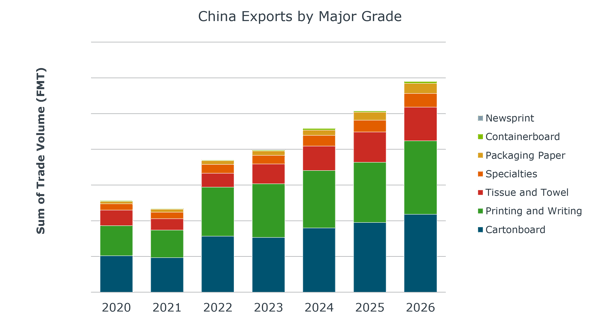
Source: Market Trends, FisherSolve, ResourceWise 2026
When additional Chinese production enters international markets, those tons compete with regional producers and other exporters for the same customers. That can affect operating rates, margins, and ultimately decisions about which assets remain economically viable.
China does not need to become the dominant supplier in every country to affect market economics. If an overseas producer can make a comparable product and deliver it at a competitive price, that imported supply can influence what local customers are willing to pay.
FisherSolve’s Cost Benchmark comparison of folding boxboard (FBB) delivered to Antwerp shows how competitively priced production from China and Indonesia can challenge portions of Europe’s domestic asset base. Imports do not need to undercut every mill to constrain prices.
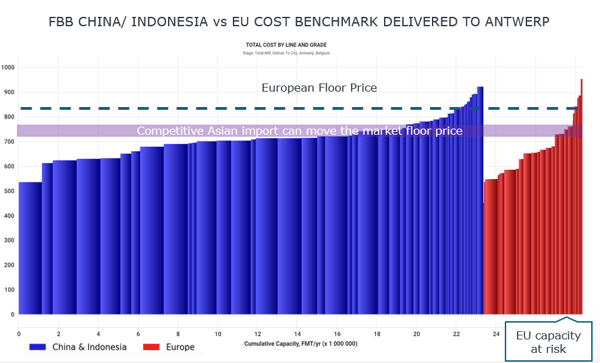
Source: Cost Benchmark, FisherSolve, ResourceWise, 2026
For higher-cost producers, input costs may rise while competitive imports limit their ability to pass those costs on. Chinese producers may also be more resilient in difficult markets when scale, financing advantages, and lower profit-margin targets allow them to compete at prices that would strain some Western producers.
Cartonboard is one area to watch closely because China has expanded capacity significantly and it is among the country’s largest paper export categories. Printing and writing papers are another: Chinese capacity has grown even as communication-paper demand has declined in many mature markets. Tissue and towel exports have increased as well.
Containerboard demonstrates why capacity alone does not tell the full story. Despite China’s enormous manufacturing base, its containerboard exports remain relatively small compared with several other grades. ResourceWise’s analysis points to recycled fiber availability and cost as an important limit on export competitiveness. Fiber, energy, asset efficiency, and integration help determine whether a mill can compete economically abroad.
According to FisherSolve®, China has added significant virgin pulp capacity in recent years, with additions exceeding 5 million metric tons in several years. Total virgin pulp capacity has grown to roughly 40 million metric tons.
China is also expanding a more vertically integrated forest-to-fiber ecosystem, increasing domestic wood production and commercial plantations while continuing to use imported wood chips and market pulp. The goal is not necessarily to eliminate imported fiber, but to give producers more options as relative costs change.
FBB offers an example. Much of China’s new capacity has been built around integrated virgin fiber. Domestic fiber, internally produced pulp, and imported fiber from markets such as Vietnam can provide alternatives when global market pulp prices rise. Integrated pulp production can also generate biomass-based energy from wood residues and pulping byproducts. Together, these factors influence fiber costs, energy use, and export competitiveness.
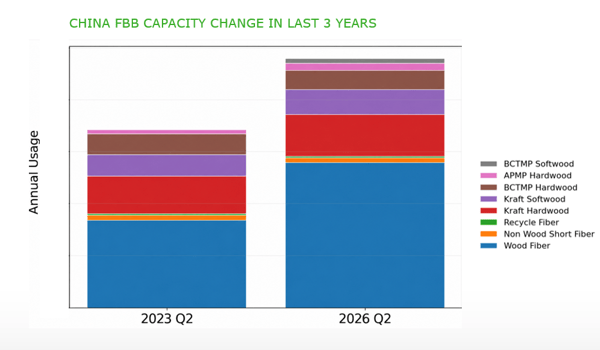
Source: FisherSolve, ResourceWise, 2026
The answer depends on more than how many new machines come online. Producers, suppliers, buyers, and investors need to know which projects reach production, what they cost to operate, where their output can compete, and which existing mills may face the greatest pressure.
FisherSolve brings capacity, mill asset, production, and cost data together so you can assess those questions for the grades and markets that matter to your business. Learn more above FisherSolve or talk with a ResourceWise expert to explore how China’s changing competitive position could affect your market.


Marko Summanen: Sep 24, 2026, 1:55:19 PM

 ResourceWise: Sep 24, 2026, 8:45:24 AM
 ResourceWise: Sep 23, 2026, 8:57:48 AM