
 Jennifer Hawkins
Global Epoxy Producers Face the Choice: Defend Price or Volume?
 Jennifer Hawkins: Oct 2, 2026, 9:29:05 AM
Raw material, energy, freight and logistics costs are rising, leaving epoxy resin producers with little room to absorb further increases. Yet the demand needed to make higher prices stick remains elusive.
European consumption is particularly weak, the US has provided little support and margins among Asian manufacturers remain razor thin. In China, operating rates remain exceptionally low, yet even reduced production has done little to tighten the market or provide meaningful support to prices. Customers are meanwhile managing inventories carefully amid weak downstream demand.
Producers need higher prices. They also need the tons.
The roots of that contradiction stretch back much further than the latest cost increases. China's rapid expansion has fundamentally altered global epoxy resin trade.
In 2020, the country imported around 405,000 tons of epoxy resins while exporting only around 47,000 tons. As domestic capacity and upstream integration expanded, imports fell sharply while exports climbed to around 262,000 tons in 2024 and 251,000 tons in 2025.
The result has been a redistribution of volume across the global market. Asian producers that once relied heavily on Chinese demand have increasingly had to find other homes for their resin, while simultaneously facing greater Chinese competition at home and in export markets.
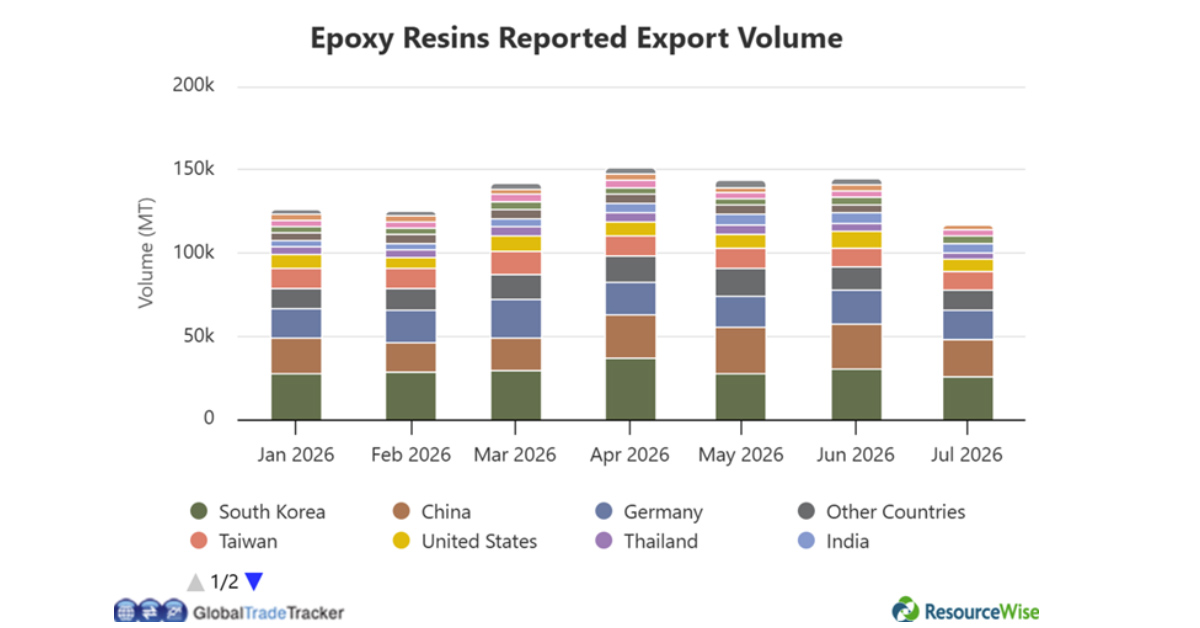
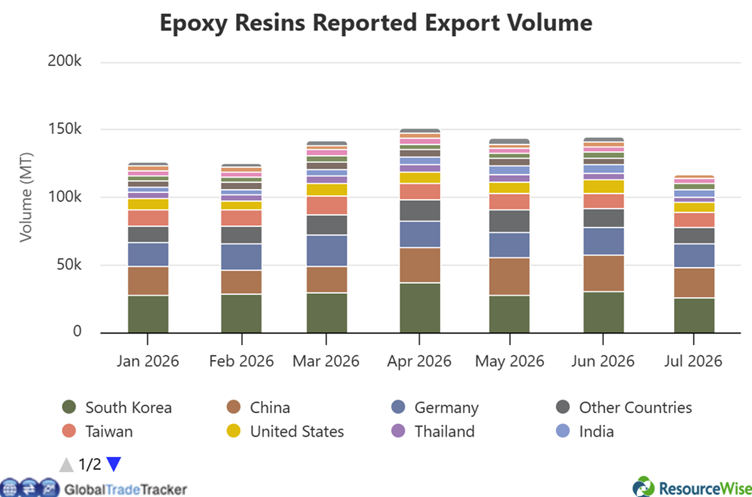
The 2026 trade pattern also reflects the extraordinary disruption following the effective closure of the Strait of Hormuz from late February. Reported global epoxy exports rose sharply from March and remained elevated through June as supply concerns prompted buyers to secure additional volumes. The surge therefore reflected not only underlying consumption but also precautionary purchasing and inventory building.
That pressure has consequences.
Chinese liquid epoxy resin plants are currently understood to be operating below 55%, with solid resin rates considerably lower. Rationalization has already begun elsewhere.
Olin has reduced or closed epoxy operations in South Korea, Brazil and the US, while Westlake permanently closed its Pernis site in 2025, including epoxy resin, BPA and ECH production. Upstream, INEOS announced plans to permanently close ECH and allyl chloride operations at Rheinberg during 2026.
Governments have increasingly turned to tariffs and trade defense, adding another layer of disruption to global chemical trade. In the US, wider tariff measures have affected sourcing decisions and landed costs across chemical supply chains, while epoxy resins have faced their own specific trade actions.
The US imposed anti-dumping duties on epoxy resin from South Korea, Taiwan and Thailand in 2025, alongside countervailing measures on South Korea and Taiwan. The investigations into China and India were terminated after the USITC determined imports were negligible.
Europe imposed definitive anti-dumping duties on China, Taiwan and Thailand in July 2025. Meanwhile, its investigation into South Korean material was terminated because the European Commission said there was insufficient evidence of dumping.
A year later, the trade statistics provide an interesting early answer to what happened next.
EU epoxy resin imports from China collapsed from 25,300 tons during January-July 2024 to just 3,100 tons during the same period of 2026. But Europe's overall imports did not disappear. After falling to 96,700 tons in January-July 2025, total imports rebounded almost 10% to 106,000 tons in 2026.
South Korean-origin volumes reached 48,300 tons, up from 34,400 tons during the same period in 2024, while India has also gained ground. However, the trade data needs careful interpretation.
Following the closure of European production, some suppliers are sourcing Asian material to continue supplying their existing European businesses. Rising imports from South Korea therefore do not necessarily represent an equivalent increase in market share for South Korean producers.
The US tells a somewhat different story. Total January-July imports fell from 73,300 tons in 2024 to 55,900 tons in 2026. South Korea still accounted for 29,100 tons, more than half of the total. Taiwan's volumes have fallen particularly sharply, from 11,900 tons in 2023 to 2,900 tons this year.
Trade defense can accordingly change both the volume and origin of imports. What it cannot do is eliminate the underlying global surplus.
This helps explain why some European producers are already looking beyond anti-dumping duties.
Olin and Spolchemie, alongside several composites producers, are supporting possible safeguard measures covering epoxy resins and other composite raw materials, potentially including quotas.
The debate is also feeding into the EU's wider discussion over strategically important chemical production through the Critical Chemicals Alliance. The CCA was established to identify chemical production considered critical to Europe's economy and address risks from plant closures, trade disruption and import dependency. Its work includes identifying critical molecules and production sites, monitoring trade flows and considering where investment or policy support may be needed to maintain European capacity.
While Europe and the US have focused heavily on the border, China is increasingly looking inside its own market.
China's anti-involution campaign is targeting disorderly low-price competition, rather than accepting the broader argument that Chinese industry has simply built too much capacity. The government's focus is on how companies compete and price their products, with an emphasis on improving efficiency, quality and innovation rather than simply removing capacity.
Rules issued in September allow regulators to examine individual production costs, or industry-average costs where individual costs cannot be established, when investigating suspected low-price competition. Capacity utilization can also be considered when calculating individual costs, although Chinese authorities stress that companies retain autonomy over their own pricing
Epoxy resins have not been specifically identified under the new rules, so the implications remain uncertain. But with Chinese epoxy operating rates so low, the direction is worth watching. If the broader anti-involution campaign eventually discourages producers from selling uneconomic tons simply to maintain market share, it may affect not only domestic pricing but also the volume of tons seeking a home overseas.
And that brings the industry back to its immediate problem: cost pressure is coming from multiple directions.
Middle East tensions pushed crude oil sharply higher during September, adding to petrochemical feedstock costs. Benzene has been particularly painful, with US spot values exceeding $5.50/gal and European values remaining above €1100/ton.
Logistics are adding further pressure. Late-September container rates were around $8100/FEU from Asia to the US West Coast and $9600/FEU to the East Coast, while Asia-North Europe rates remained around $3700/FEU. US diesel also rose 14% during September to $6.38/gal.
In Europe, record-low Rhine water levels are restricting barge capacity and raising inland freight costs, while natural gas costs have risen amid relatively low inventories and competition with Asia for LNG. US road logistics are also tightening, with market participants reporting driver shortages, cancelled loads, higher rebooking costs and longer delivery lead times.
Against that backdrop, producers are trying to push costs downstream. US epoxy resin producers have announced increases of 10-12 c/lb for October business, while European suppliers are seeking an additional €200/ton. The European increase follows an earlier attempt that gained limited traction, with market sources indicating that around €50/ton has so far been achieved at some accounts.
But buyers have their own margin and inventory problem. The precautionary buying triggered by the Middle East disruption helped secure supply earlier in the year, but left many customers carrying higher inventories just as underlying demand is weakening and markets enter the seasonally slower year-end period. At the same time, companies are under pressure to release working capital before year-end, giving them another reason to reduce purchases.
Buyers therefore face a double drag: weaker underlying consumption and the need to work down inventories. For coatings, composites and other epoxy-consuming industries already struggling to pass costs through to their own customers, resisting another round of resin increases is as much about protecting competitiveness and cash as negotiating price.
That tension is becoming increasingly important as 2027 contract discussions begin. Producers do not want to surrender customer positions, while buyers cannot afford to accept increases that leave them uncompetitive.
Where offshore material still makes economic sense, they have every incentive to look for it. The result is an uncomfortable stalemate.
Producers' costs tell them to defend price. Their operating rates tell them to defend volume. Buyers need secure supply, but their own markets tell them to defend cost. Something eventually has to give.

Jennifer Hawkins: Oct 2, 2026, 9:29:05 AM

 ResourceWise: Oct 1, 2026, 1:54:23 PM
 ResourceWise: Sep 29, 2026, 10:23:04 AM