 Rachel Uctas
Changing Global Plasticiser Trade Flows
 Rachel Uctas: Oct 29, 2026, 10:05:08 AM

The global plasticisers market is seeing a shift in international trade flows, with increasing volumes of material moving between regions and new trading relationships beginning to emerge. At the same time, growing competition from imports is prompting some countries to introduce measures to protect their domestic industries.
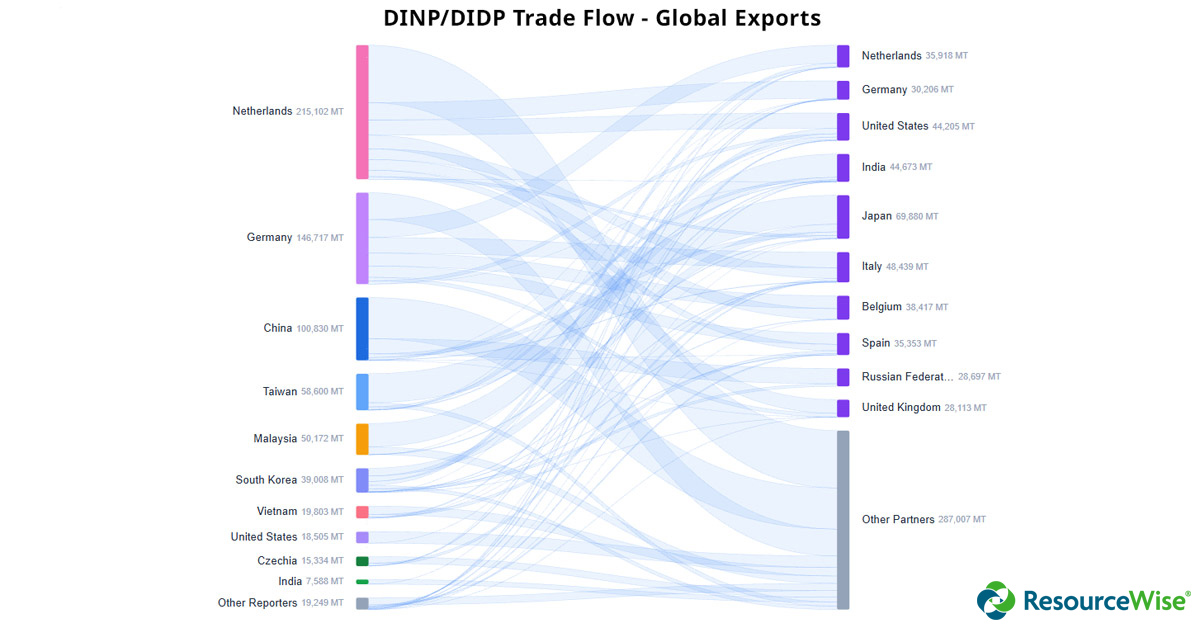
(Source: ResourceWise Compass)
Brazil and India are among the markets taking action against imported plasticisers, while in Europe, supply disruptions and logistics challenges are encouraging buyers to consider new sources of material. These contrasting developments highlight how the global plasticisers market is becoming increasingly complex, with both protectionism and supply security playing a greater role in purchasing decisions.
Brazil has experienced a sharp increase in plasticiser imports in recent years, particularly DOTP from South Korea and China. This trend has accelerated significantly in 2026, putting growing pressure on domestic producers.
During January–July 2026, Brazilian DOTP imports reached 22536 tons, more than three times the 7226 tons imported during the same period in 2025. This represents an increase of 212%, compared with just 6103 tons in 2024.
Imports of traditional phthalate plasticisers have also increased, although at a more moderate pace. DOP imports rose by 24% year on year to 8834 tons, while DINP imports increased by 17% to 3080 tons.
Combined imports of these three plasticisers more than doubled from approximately 16953 tons in January–July 2025 to 34450 tons in the same period of 2026.
The influx of competitively priced material has put considerable pressure on local producers, contributing to falling prices and reduced operating rates. Brazil's domestic plasticiser industry includes Elekeiroz, which produces at Camaçari, and Petrom, which operates a facility at Mogi das Cruzes.
In response to the growing import competition, Brazil launched an anti-dumping investigation in June 2026 into imports of DINP, DOP and DOTP from South Korea, Chile and Colombia. If duties are introduced, they could reduce the competitiveness of imported material and provide some relief to local producers.
However, the investigation is not the only development affecting plasticiser trade flows in South America.
In early August, Chilean producer Panimex suffered a serious explosion and fire at its facility in Quilicura, near Santiago. Panimex has traditionally been an important supplier of plasticisers to Brazil, supplying an estimated 7000 tons per month, including around 5000 tons of DOP, as well as substantial volumes of DIBP.
The disruption has already created opportunities for other producers, with some buyers who previously relied on Panimex seeking alternative sources of supply.
Panimex has also benefited from preferential access to the Brazilian market under the Mercosur–Chile trade agreement, which allows qualifying Chilean-origin plasticisers to enter Brazil free of normal import tariffs. However, any anti-dumping duties introduced following Brazil's investigation would be separate from these existing preferential arrangements.
India is another important plasticiser market where import competition has prompted action to protect the domestic industry.
The country has significantly expanded its plasticiser production capacity in recent years, with KLJ the largest producer, followed by Payal. India also remains one of the strongest growth markets for plasticisers, supported by economic growth estimated at around 7% in 2026. DINP demand growth is estimated at approximately 4–5%.
However, growing domestic production has faced strong competition from imported DINP, particularly from Malaysia.
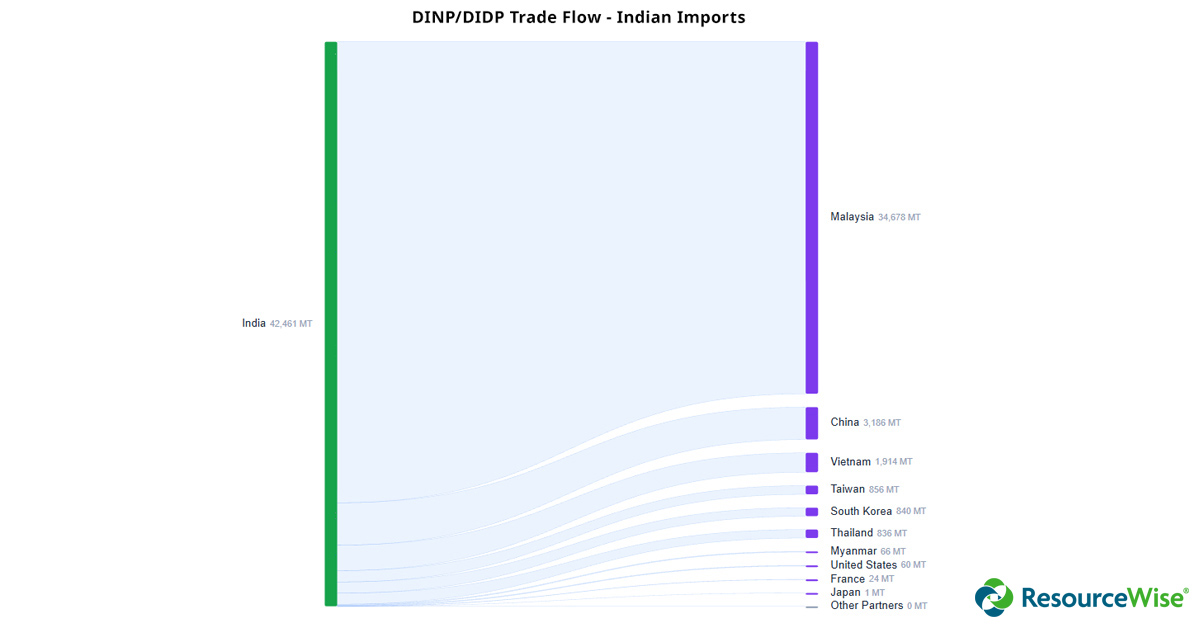
(Source: ResourceWise Compass)
Following an application by KLJ Plasticizers Ltd and KLJ Petroplast Ltd, India launched an anti-dumping investigation into Malaysian DINP imports. South Korea was originally included in the application but was excluded from the investigation after the preliminary injury assessment showed a negative margin.
The Directorate General of Trade Remedies issued its final findings on 25 September 2026, concluding that Malaysian DINP had been dumped and that the domestic industry had suffered material injury. Malaysian imports accounted for approximately 79% of India's total DINP imports during the investigation period.
The authority recommended anti-dumping duties for five years, ranging from $111/ton for UPC Chemicals to $277/ton for other Malaysian producers and exporters.
If implemented, these measures could provide greater protection for Indian producers while potentially encouraging Malaysian exporters to seek alternative markets.
The US has also taken measures to protect its domestic plasticiser industry, with anti-dumping duties imposed on DOTP imports from several countries. However, the US remains a net importer of other platisicers such as DINP, with Evonik Oxeno and Asian suppliers playing an important role in meeting domestic demand.
While Brazil and India are seeking to limit the impact of imports on their domestic industries, the situation in Europe is rather different.
The European DINP market is normally well supplied by domestic production, but significant supply disruptions this summer have encouraged buyers to look increasingly towards alternative sources.
Exceptionally low rainfall during the summer has resulted in critically low water levels along the Rhine, creating serious transportation difficulties for chemical producers.
Both BASF and Evonik Oxeno declared force majeure in July following problems associated with moving raw materials and finished products to and from their Ludwigshafen and Marl sites.
BASF has been particularly badly affected, reportedly supplying lower volumes of DINP and DPHP than initially expected during September and October. Evonik Oxeno has faced fewer direct constraints but has experienced significant disruption to shipments of isononyl alcohol (INA) to its global partners.
With Rhine water levels remaining exceptionally low, uncertainty over European DINP and DPHP availability has continued into October.
These disruptions have prompted some European buyers to consider increasing their imports of DINP, including material from China, to reduce their exposure to further supply shortages and potential price shocks in the future. Although imports from Asia remain relatively modest, there are signs that new trade flows are developing. South Korea and Vietnam have reportedly been supplying some additional volumes in recent months.
Imports from China have increased modestly over the past two years, and remain a relatively minor source. In 2026 from January to July, Western Europe has imported 792 tons of DINP/DIDP (which share an HS Code) from China, compared with 117 tons during the whole of 2025 and just 54 tons in 2024.
While these volumes remain small, the increase suggests that European buyers are becoming more willing to consider Chinese material.
The difficulties caused by low Rhine water levels are also prompting producers and consumers to reconsider their longer-term supply-chain strategies.
BASF has already begun investing in alternatives to Rhine transportation. In August 2026, the company started modernizing its intermodal rail terminal at Ludwigshafen, with an investment exceeding €100 million and approximately €51 million in federal funding. Scheduled for completion in 2028, the project is intended to improve transport reliability and reduce the site's dependence on river shipping.
Some European plasticiser buyers are also reportedly considering increasing their storage capacity, allowing them to build inventories when market conditions are favorable or import additional material when necessary.
For these consumers, the cost of holding additional stocks may be outweighed by the benefits of greater supply flexibility, particularly if low Rhine water levels continue to cause disruptions in future years.
As supply disruptions and trade measures reshape plasticiser markets, visibility into where material is moving can help businesses assess alternative sources, competitive pressures, and emerging opportunities.
Our new market intelligence platform, ResourceWise Compass, brings these shifts into focus. Its Global Trade feature, used to create the charts in this article, helps users examine international trade flows. Combined with pricing data and expert market analysis, Compass provides context to support more informed sourcing and commercial decisions.

 ResourceWise: Oct 27, 2026, 3:53:04 PM